Platform design
Complex workflows
Quality at scale
Global commerce
Establishing Platform Quality at Scale
Company
BigCommerce
Role
Director of Product Design
Scope
Platform design, UX quality, Navigation
Year
2024–2025
Platform inconsistency had become a business risk at BigCommerce, but it kept losing out to feature work.
I built the case, founded a new function, secured resource commitments from the CPO and VP Engineering, and led a team to revamp the design building blocks into an Enterprise grade system.
This foundation allowed us to launch improvements to dozens of features and products across the platform, with the Control Panel used by 120K+ merchants as one of my favorite examples.
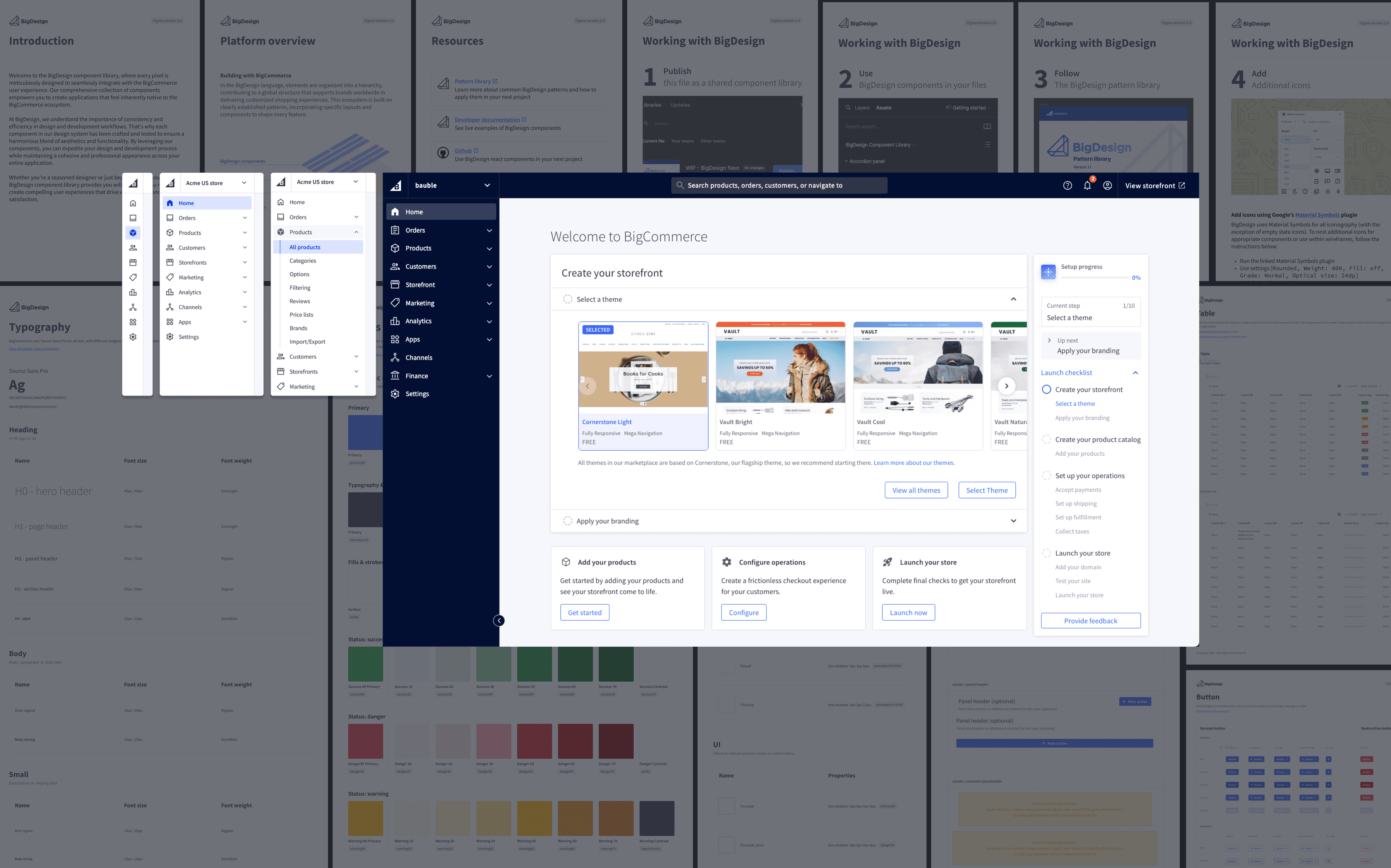
After 6 months of focused effort, we turned BigDesign, our design system, into a source of truth; for the first time we had a trusted, actively maintained system with clear ownership and governance that designers understood and developers bought into. This fueled improvements to dozens of product releases across our platform, including a redesign of our Control Panel navigation and core experience.
After 6 months of focused effort, we turned BigDesign, our design system, into a source of truth; for the first time we had a trusted, actively maintained system with clear ownership and governance that designers understood and developers bought into.
The CHALLENGE
BigCommerce's admin platform had grown through years of fast feature delivery across 20+ independent product teams. Our design system, BigDesign, lacked clear ownership and adoption. Core surfaces like navigation, settings, and utilities had accumulated years of debt, and there was no shared definition of quality to hold teams accountable.
Fragmentation was showing up in NPS feedback, support tickets, and partner escalations. As BigCommerce moved upmarket, this became a business risk. Enterprise merchants, partners, and internal teams needed a platform that felt coherent, trustworthy, and scalable.
The real challenge wasn't fixing the design system. It was changing how an entire organization — Product, Engineering, and Design across 20+ domains — thought about and executed with quality.
approach
I approached this as an organizational change problem, not a design execution one.
1. Established Craft as a Source of Truth I formalized Platform Design as a new function and directed the team to build a unified source of truth — refreshed Figma libraries, a data visualization guide, and comprehensive pattern documentation. To institutionalize this, I updated the Definition of Done to require design reviews and system adherence, shifting the culture from rapid output to systemic coherence.
2. Built a Shared Language for Quality I anchored Platform Design to Developer Experience — a high-priority domain with GTM goals — to secure engineering resources and credibility. I defined UX quality, launched a UX debt program, and ran systematic audits logging 700+ issues. This shared language across the org provided the rigorous documentation needed to earn BigCommerce's first ISO 9001 certification.
3. Built Visible Proof of Change To create momentum, I leveraged a design-engineering hackathon to tackle Control Panel navigation, a long-standing merchant pain point, and turned it into a high-visibility coded prototype. That visible proof of concept became the catalyst for securing leadership support for a full platform redesign.
60-70% platform was outdated
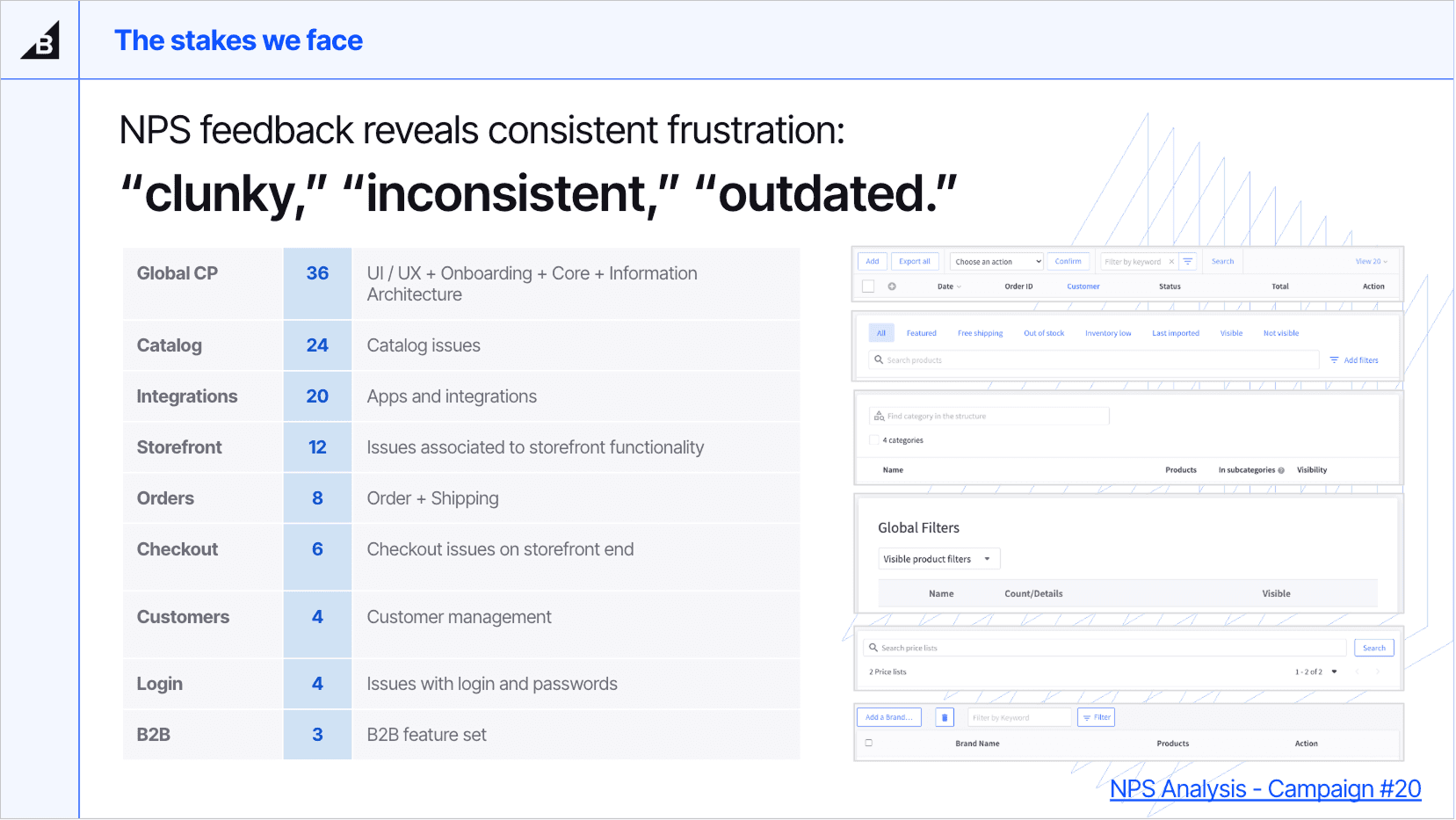
NPS feedback revealed user frustration.
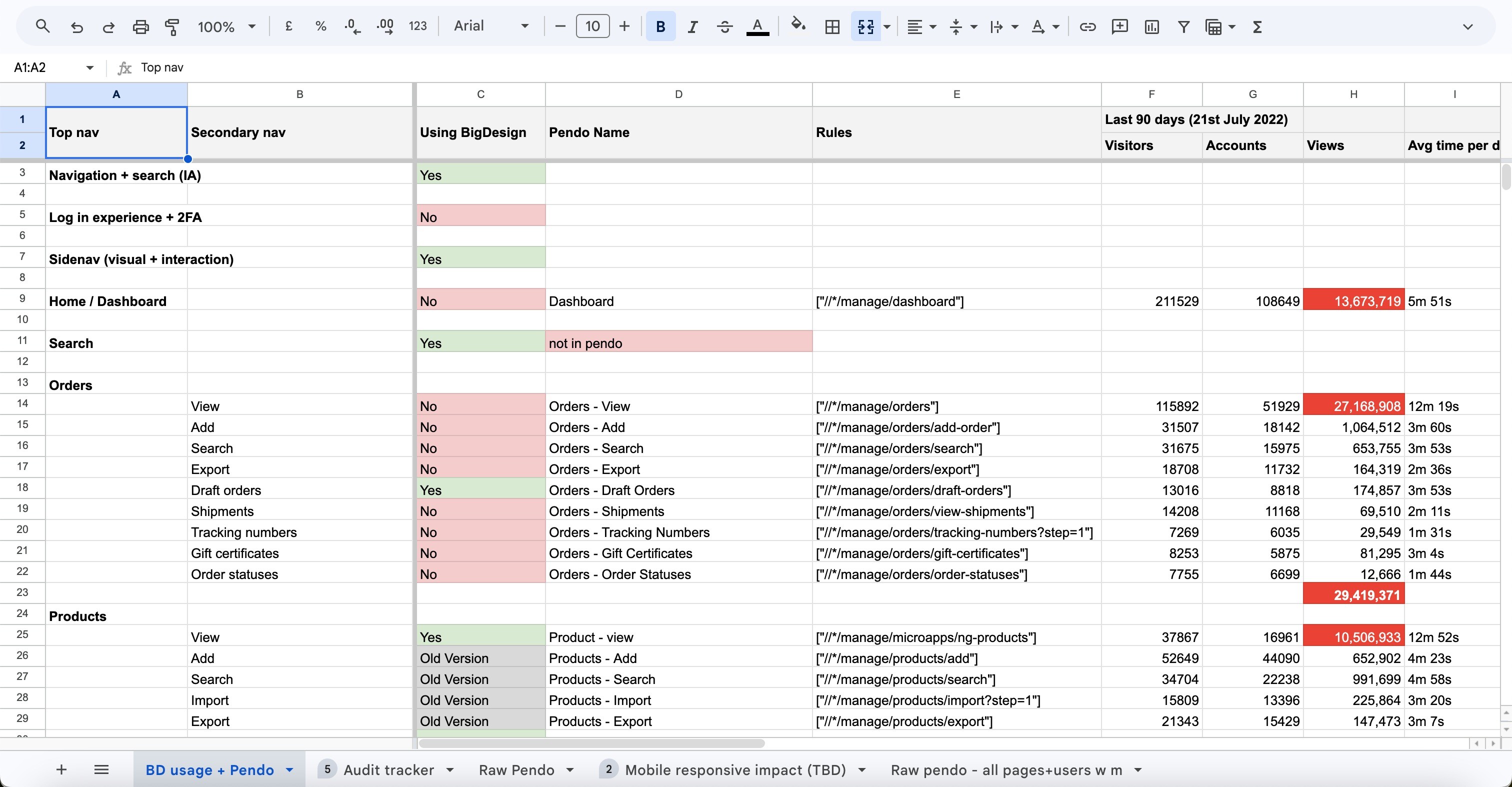
Our audit revealed that 60% of the pages and 75% of our page views on our platform were old, outdated legacy patterns, not matching the rest of the platform.
“Every time…it downloads in a different manner, I can hear the the gears of my brain grinding, maintaining consistency across page to page to page.”

David, E-commerce Manager
BigCommerce customer
products: before & after platform design
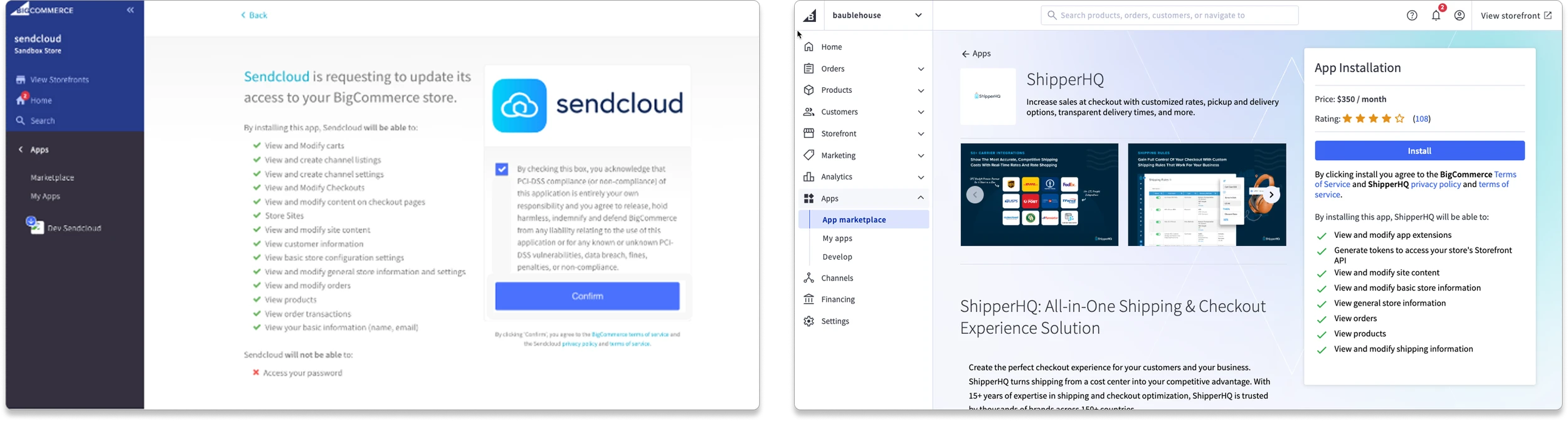
The app installation landing page was upgraded to align with the new pattern library and guidelines.
The app installation landing page was upgraded to align with the new pattern library and guidelines.
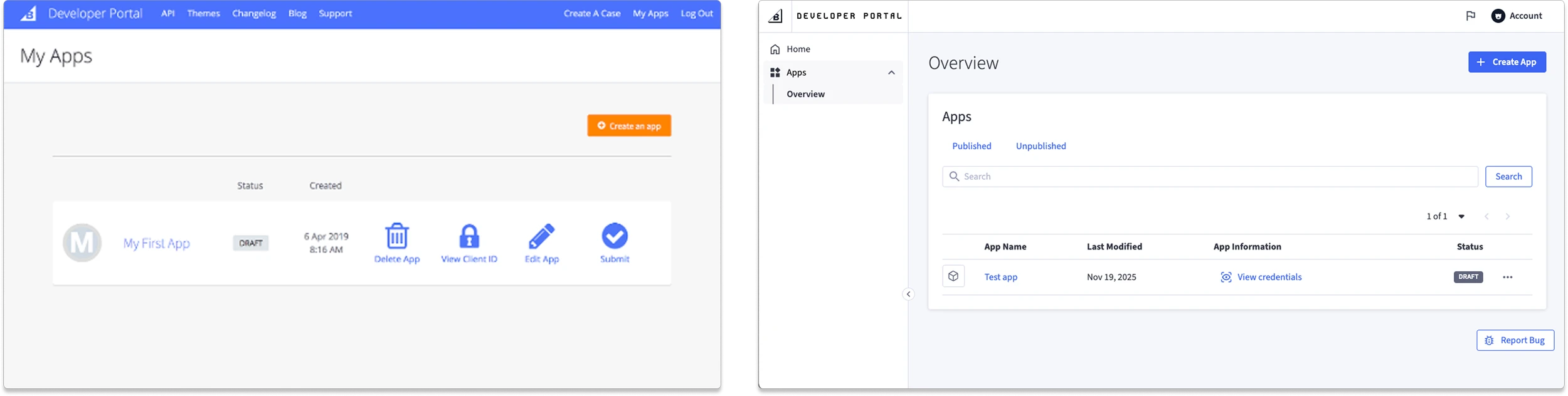
The developer portal was redesigned using the BigDesign library to support the Open SaaS strategy.
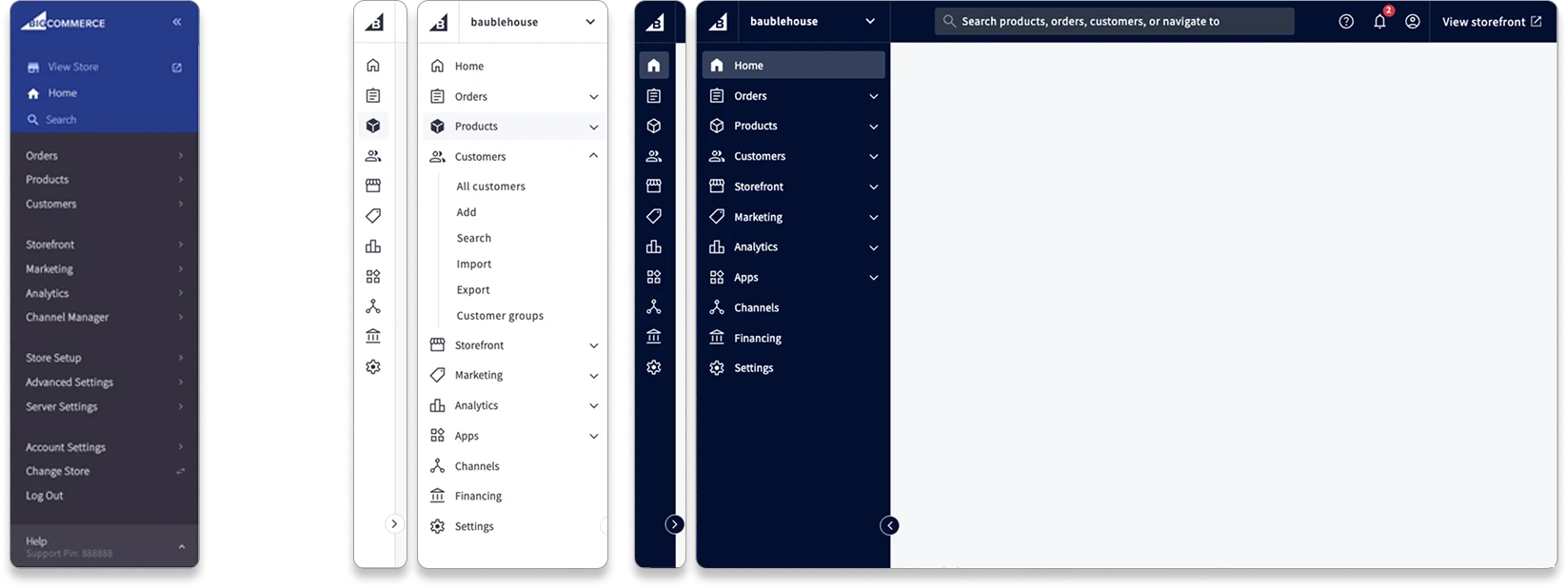
Control panel navigation was redesigned with adherence to BigDesign to create a consistent, modern experience.
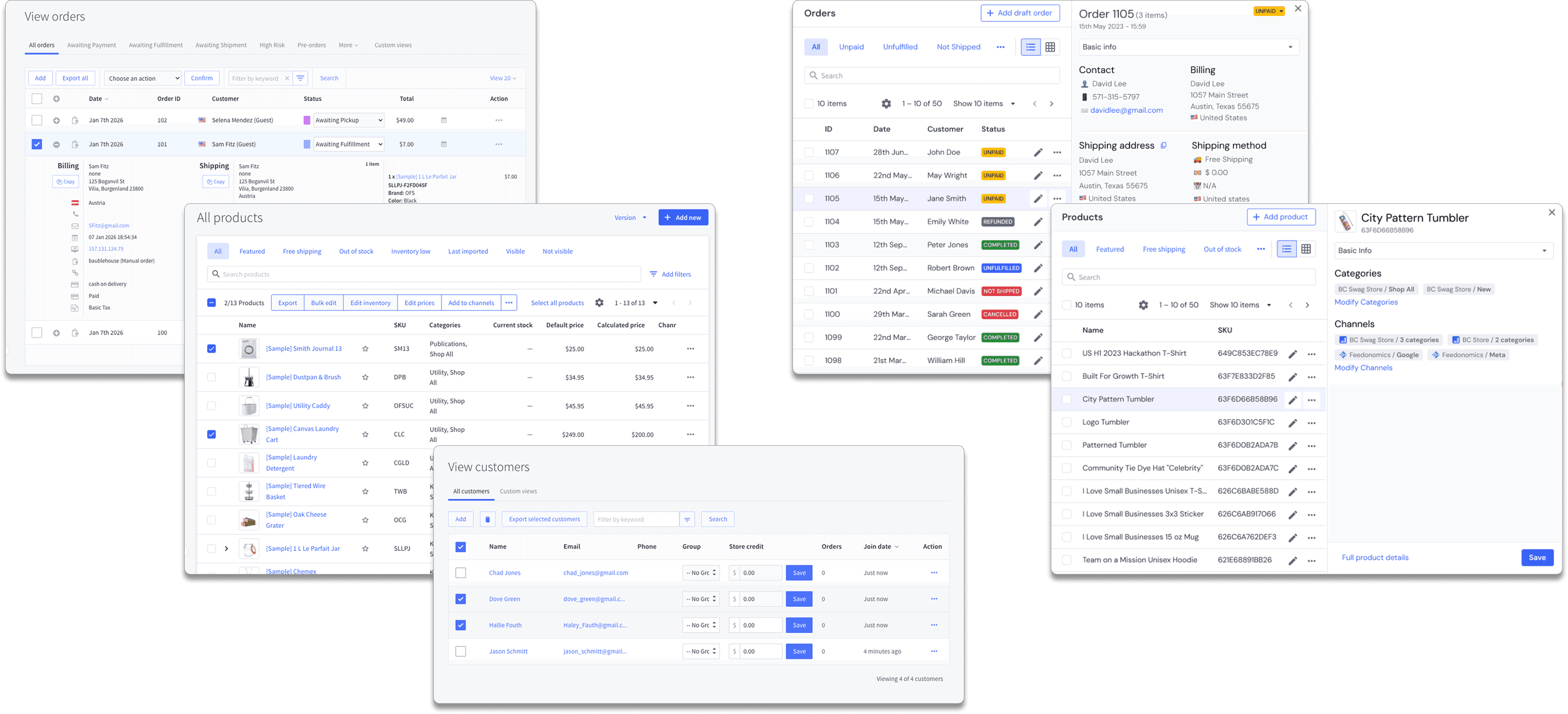
(Wireframes only) Before we had three different table styles with different behaviors. After we unified styles and behaviors utilizing a side panel, to address the need for a consistent view of table data.
results
The results were both organizational and measurable. Design went from advocating for quality to being part of how quality was defined and enforced — teams had shared language, clearer ownership, less rework, and stronger trust in cross-team delivery.
Within 6–12 months, using BigDesign shifted from "nice to have" to a trusted necessity across the org:
Published ~30 patterns and ~50 components for BigDesign; 40 components and 40 page templates for Catalyst storefronts
~90% BigDesign adoption across shipped products
~20% improvement in developer efficiency for common front-end patterns
Logged 700+ UX debt issues, resolved ~290 — establishing a baseline and a repeatable system for continuous improvement
2,500+ guide and pattern downloads via Figma Community
The Control Panel redesign was the clearest proof of this work at scale — a full release executed consistently across 30+ features using shared patterns and foundations, with measurable reduction in related customer support calls.
There were improvements to what we shipped, but also the change was cultural. Teams now had a shared language for quality, clearer ownership, less rework and higher trust in cross-team delivery - and the design team had more control of the work we did, thus more pride.
In ~6-12 months, using the BigDesign library shifted from “nice to have” to a trusted necessity.
Published ~30 patterns, ~50 components for BigDesign; 40 components, 40 page templates for Catalyst storefronts.
~20% improvement in developer efficiency for common front-end patterns
~90% adoption of BigDesign across shipped products (BigDesign usage in new releases)
We logged 700+ UX debt issues and resolved ~290, creating a baseline and a repeatable system for continuous improvement.
2,500+ guide & pattern downloads via Figma Community
We enabled consistent execution into the wild across 30+ releases/features using shared patterns and foundations.
The Control Panel redesign was the best example of this work coming to fruition: We released a high-quality product that adhered to our quality guidelines.
1: Made Craft a source of truth
Before teams could ship more consistently, shared patterns and quality decisions needed real ownership.
I decided to invest in foundational work instead of treating design systems as side work. Rather than wait for formal permission, I pulled together several designers to define a vision, align the team around it, and drive momentum around it.
vision & alignment docs
vision & alignment docs
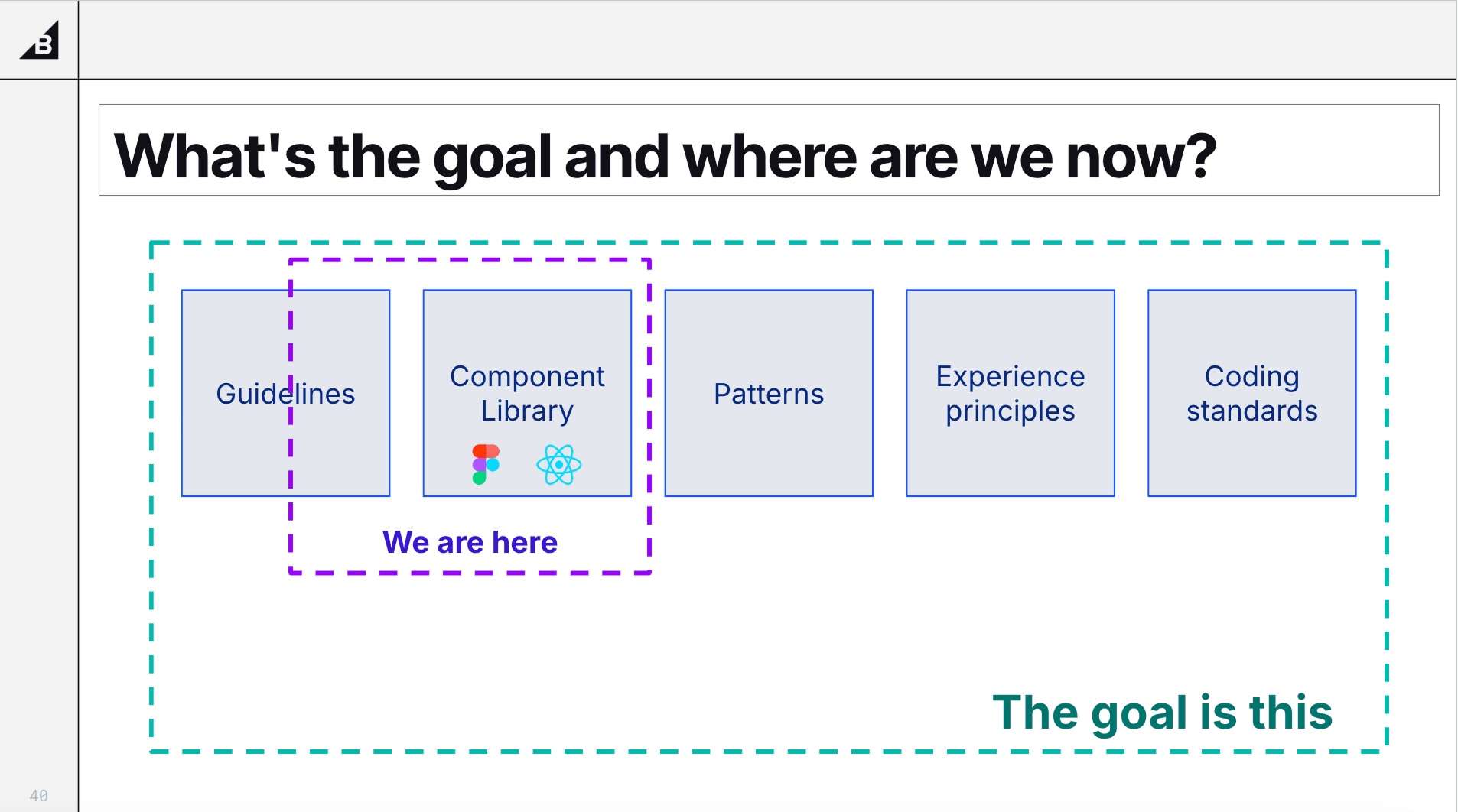
We defined what a true source of truth needed to include — from components and patterns to principles and code standards — so the work could scale beyond a library alone.
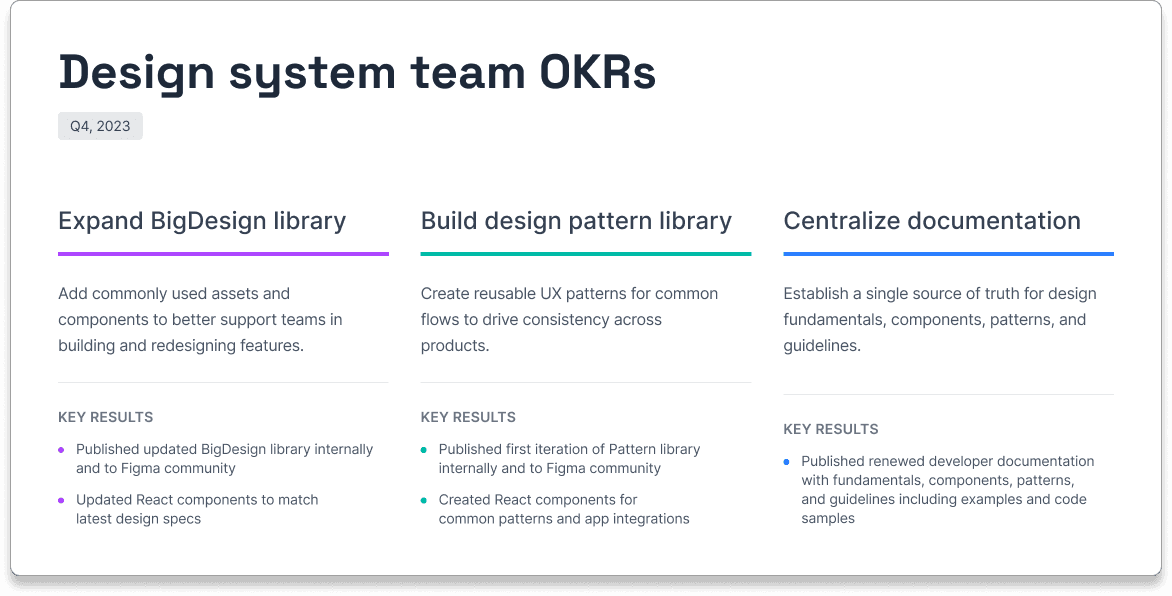
We used OKRs as the way to drive to our platform-quality goals.
We defined what a true source of truth needed to include — from components and patterns to principles and code standards — so the work could scale beyond a library alone.
We used OKRs as the way to drive to our platform-quality goals.
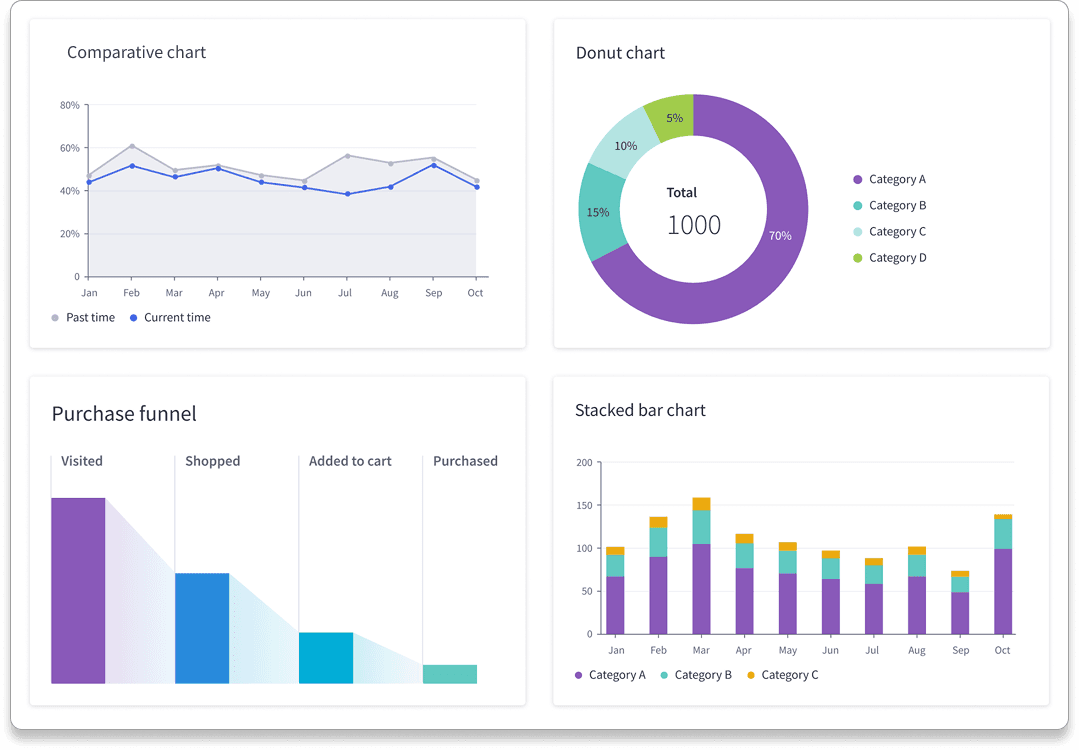
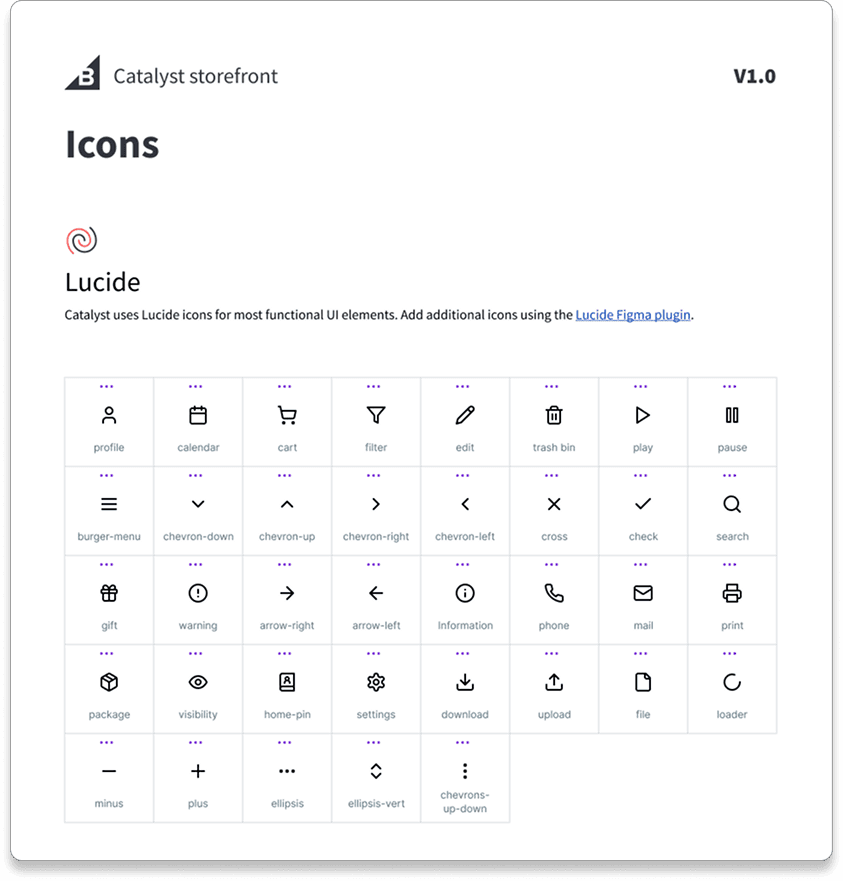
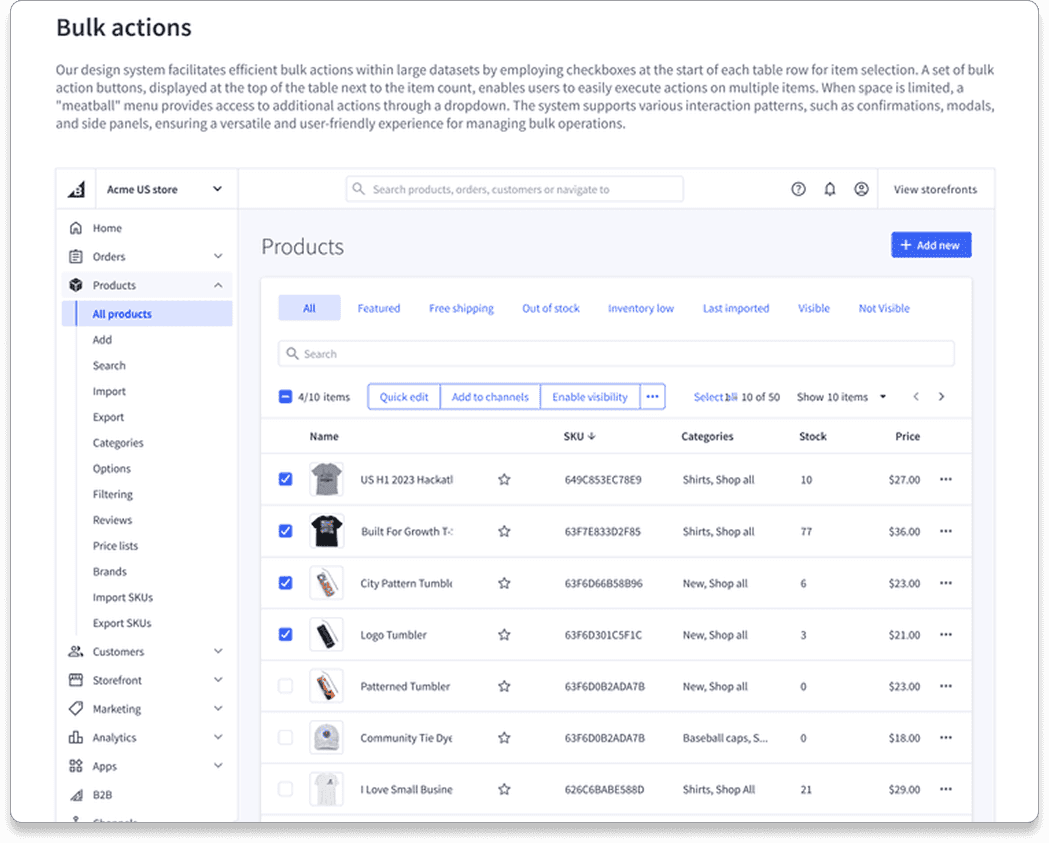
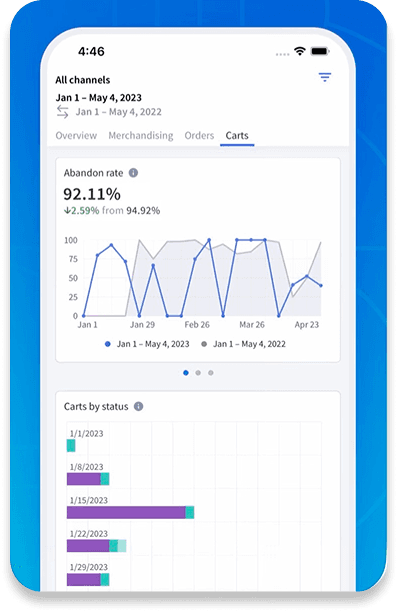
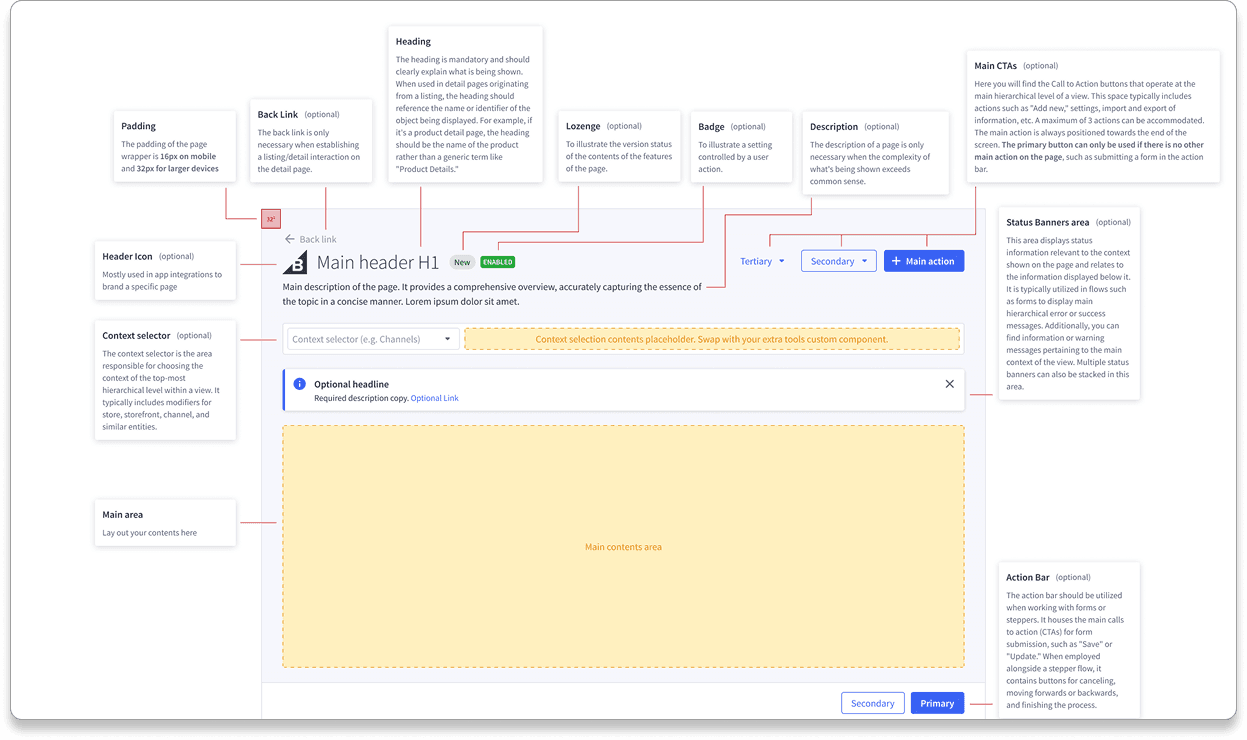
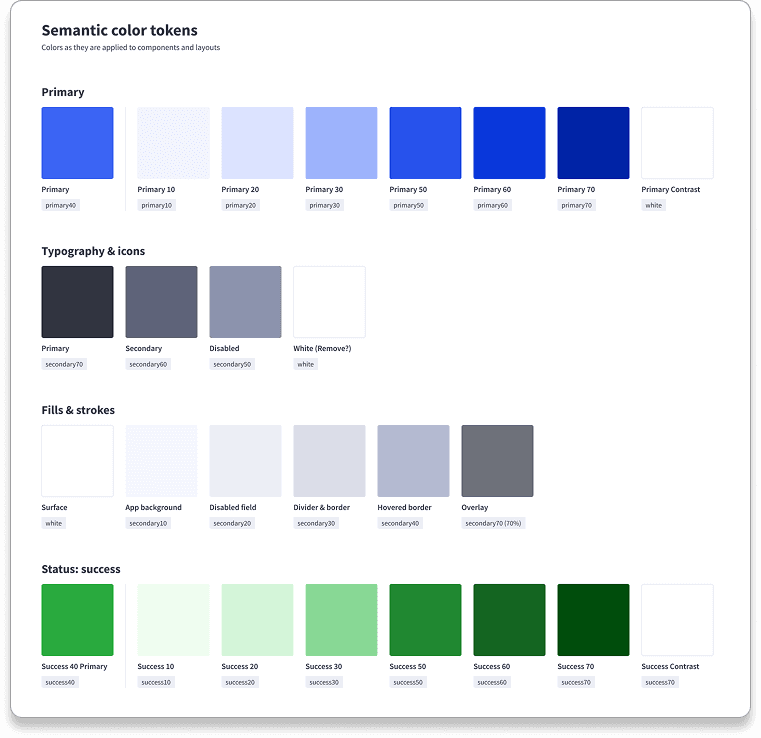
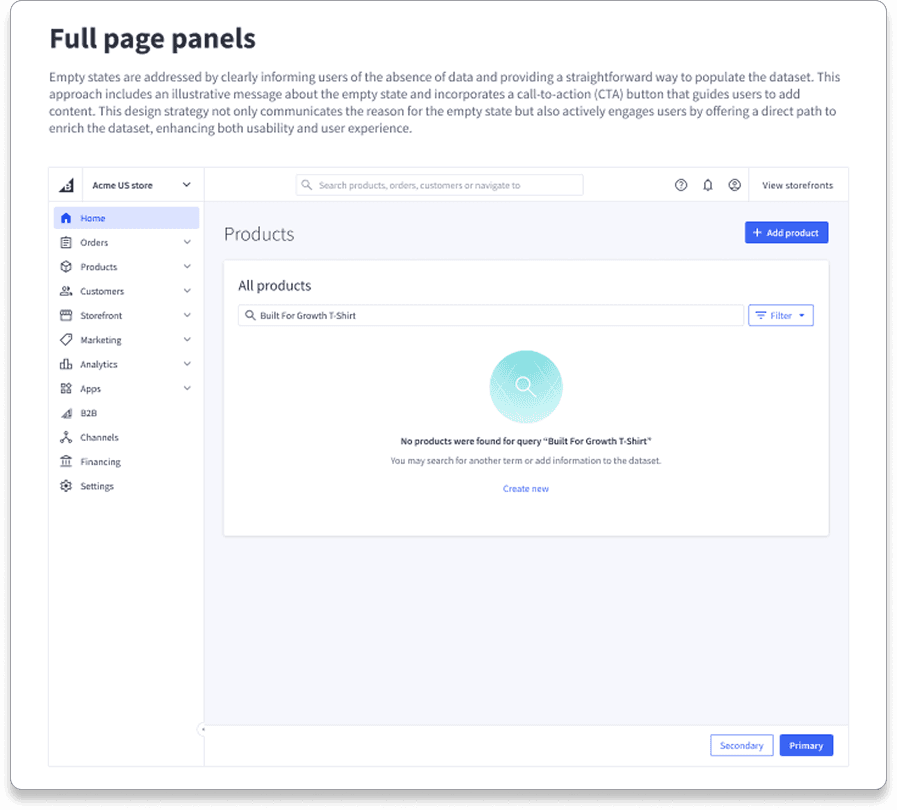
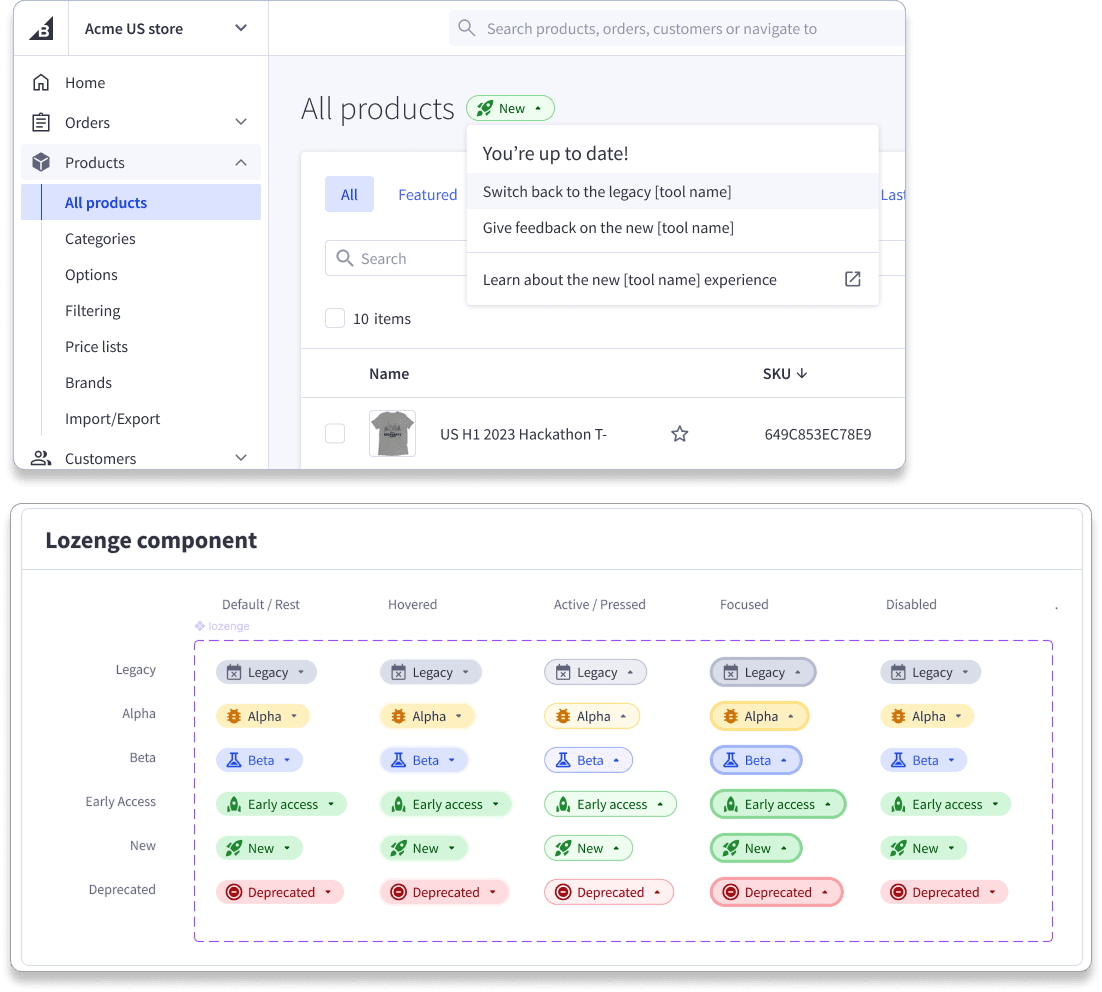
design assets & building blocks we created
These are some of the patterns, principles, and supporting assets we as a team created as a first step. This process got everyone aligned on better craft and building more consistently across the product.
UX Quality & DEBT
We went beyond just the platform design work to redefine “quality” to include usefulness, usability, consistency and desirability and shared this with our Product and Engineering counterparts.
Some of the efforts we invested in:
Created a shared defintion of UX quality; aligned Product & Engineering
Running audits of over 40 pages in the platform and created 700+ issues in Jira
Creating a UX debt audit & Jira tracking system so teams could audit, prioritize and fix issues.
Created a GPT copy bot to apply copy guidelines.
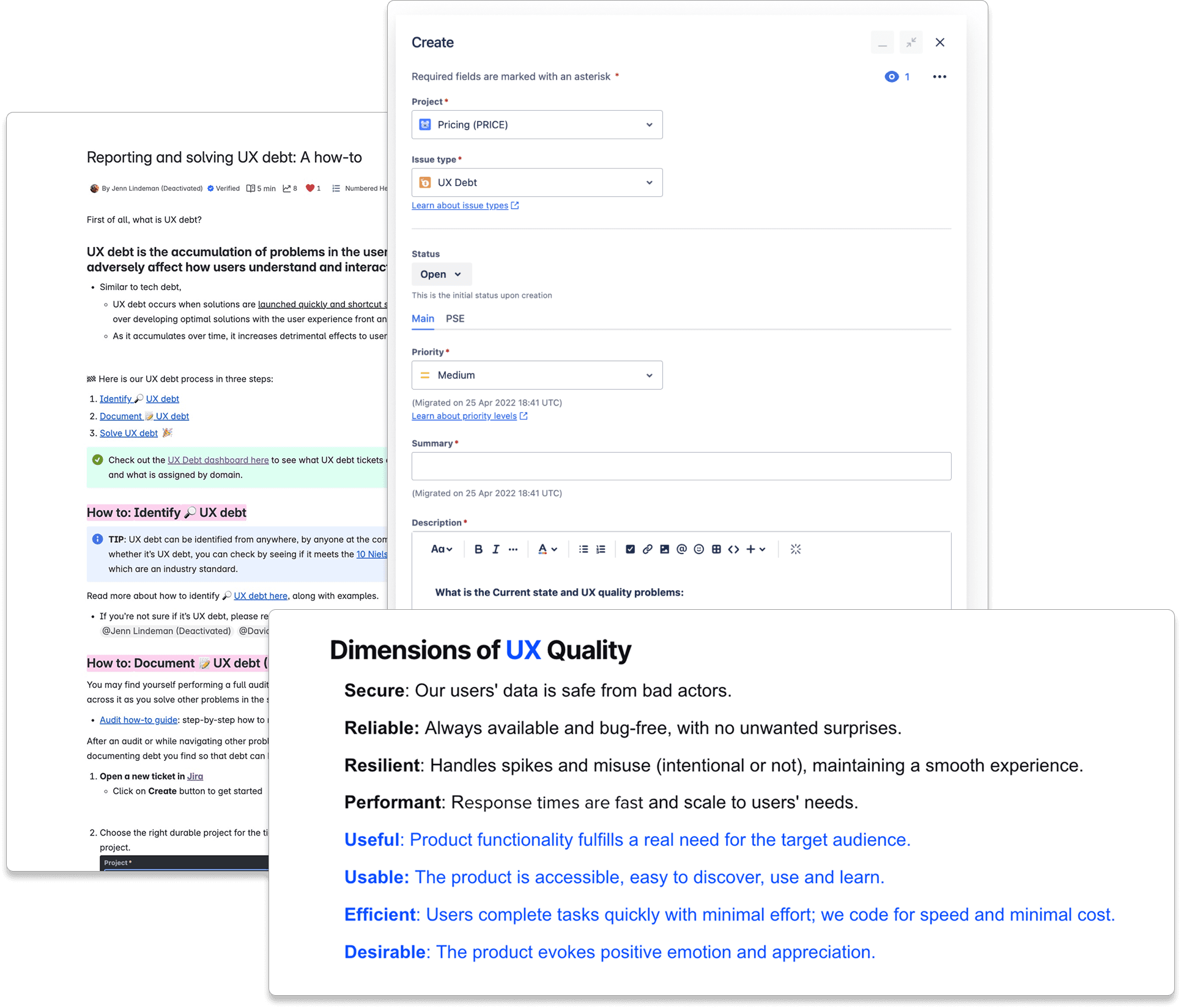
We defined what a true source of truth needed to include — from components and patterns to principles and code standards — so the work could scale beyond a library alone.
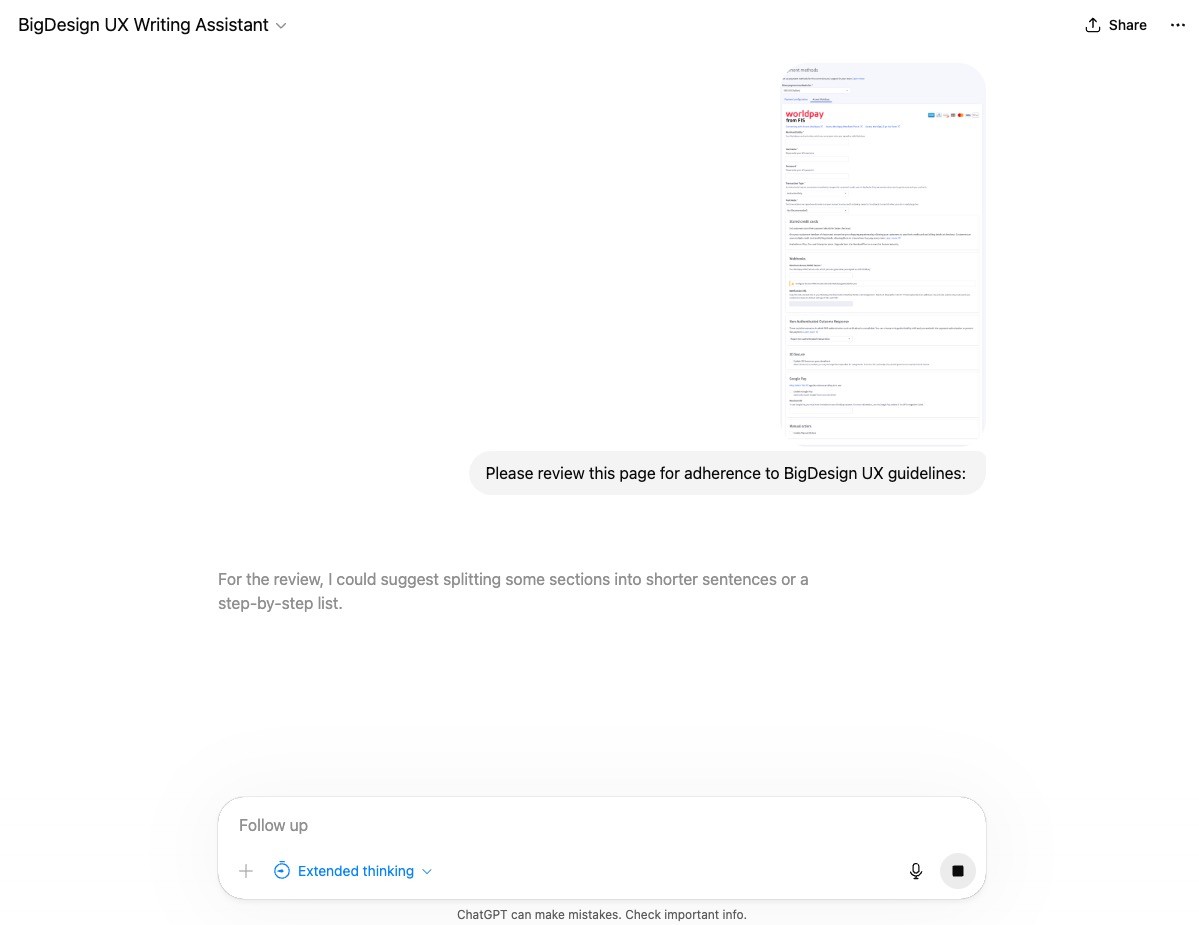
AI BigDesign Copywriter: Since much of the UX debt we found was copy-related, we created a GPT writing assistant grounded in our UX writing guidelines.
UX Quality & DEBT
We went beyond just the platform design work to redefine “quality” to include usefulness, usability, consistency and desirability and shared this with our Product and Engineering counterparts.
Some of the efforts we invested in:
Created a shared definition of UX quality; aligned Product & Engineering
Running audits of over 40 pages in the platform and created 700+ issues in Jira
Creating a UX debt audit & Jira tracking system so teams could audit, prioritize and fix issues.
Created a GPT copy bot to apply copy guidelines.
We defined what a true source of truth needed to include — from components and patterns to principles and code standards — so the work could scale beyond a library alone.
AI BigDesign Copywriter: Since much of the UX debt we found was copy-related, we created a GPT writing assistant grounded in our UX writing guidelines.
results of ux quality work
UX debt issues logged after audits
0
0
UX debt issues resolved
0
0
UX debt issues logged after audits
0
0
UX debt issues resolved
0
0
2: Getting organizational buy-in
To make Platform Design real, I needed the org to see its importance. I paired Platform Design with Developer Experience — a domain with executive attention, resources, and a GTM mandate. That positioning unlocked a direct commitment from Product and Engineering leadership: four engineering stewards dedicated full-time to reinforcing pattern adoption across teams.
Formalizing this structure sent a clear signal: teams were expected to work through Platform Design rather than continue shipping one-off solutions. It gave the designers on my team the authority they needed — and gave the broader org a shared model for how quality gets built and maintained at scale.
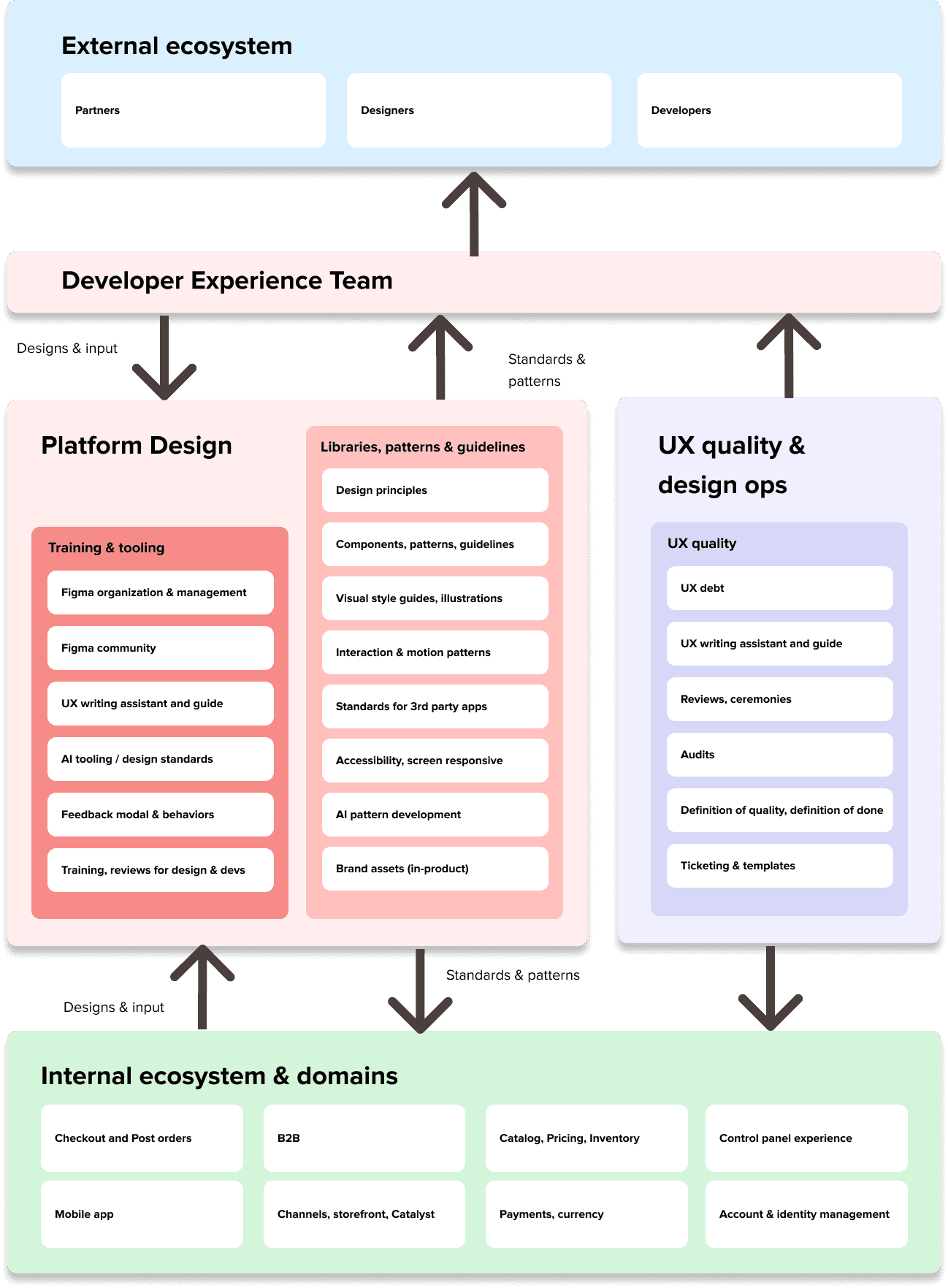
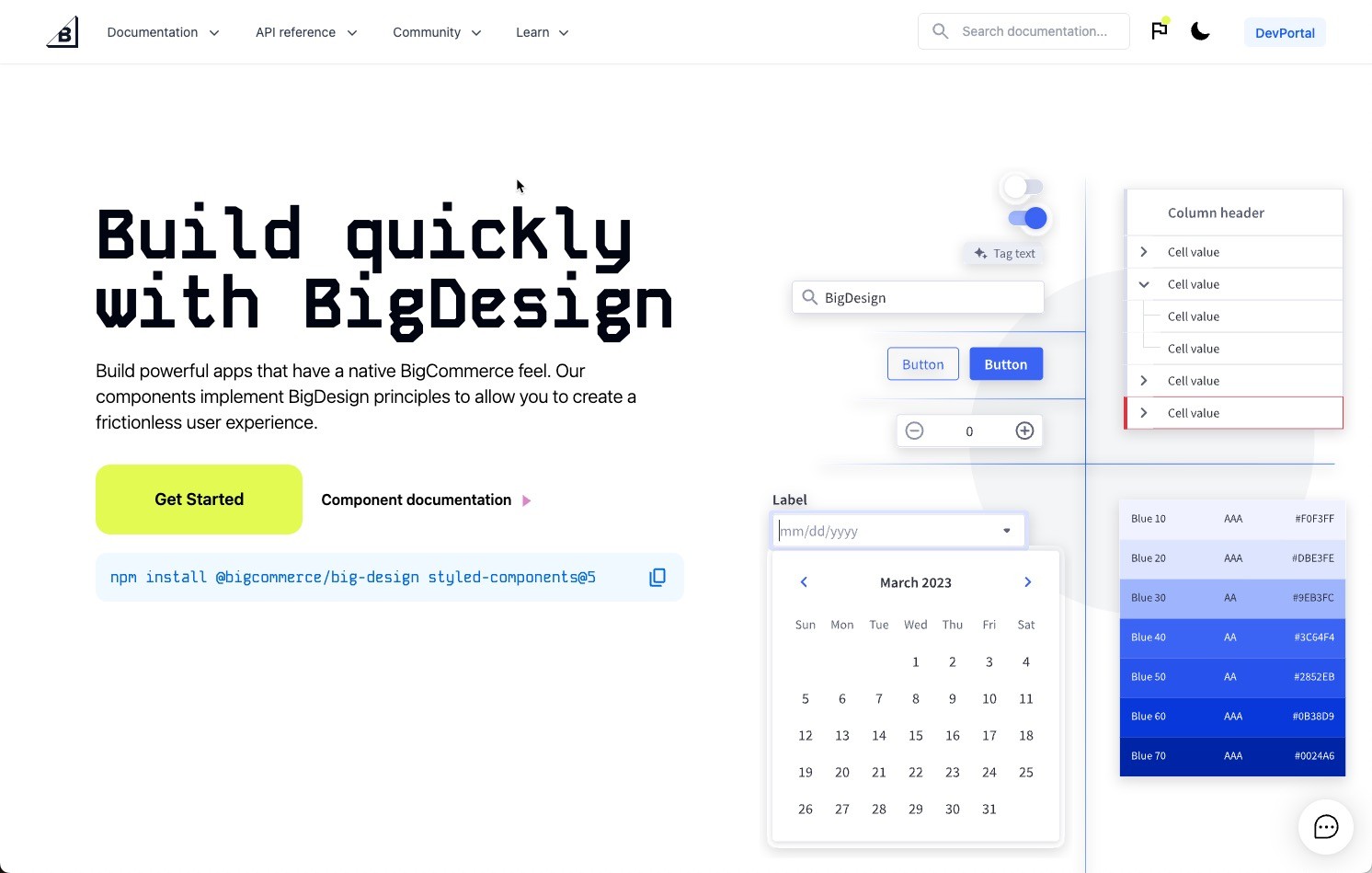
We launched BigDesign as part of our Developer center, with Figma community links and external facing resources.
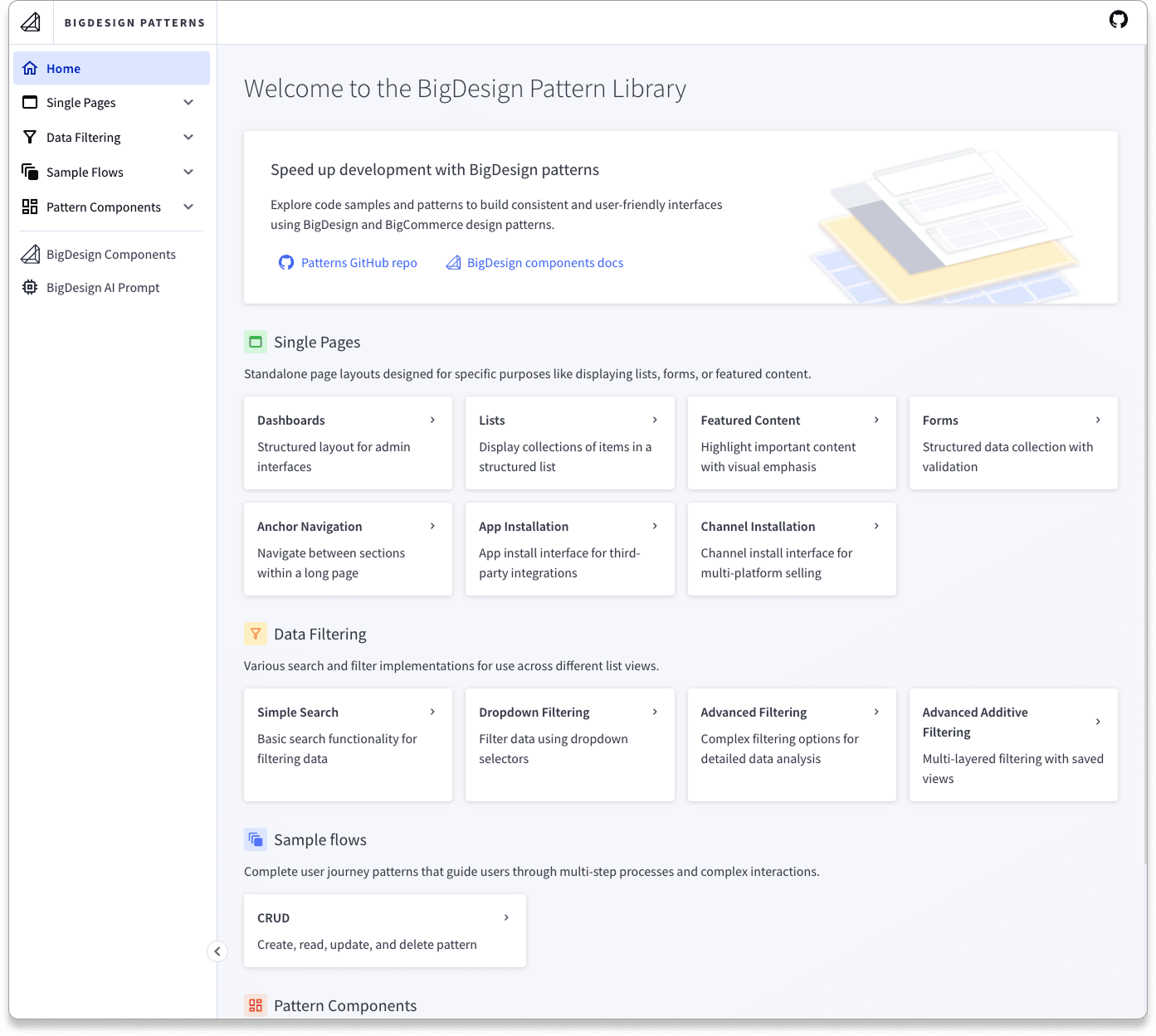
External facing pattern playground.
results of established platform design team
results of established platform design team
Asset downloads in Figma Community
Asset downloads in Figma Community
0
0
Improvement to developer efficiency
Improvement to developer efficiency
0%
0%
BigDesign adoption across shipped products
BigDesign adoption across shipped products
60%
60%
Released products & features using new patterns
15+
15+
3: LEveled up our execution
Control Panel as proof
Although there were many products we impacted, the Control Panel redesign became the clearest proof that Platform Design could influence real product outcomes. applied stronger standards, were able to develop a clearer information architecture, and implemented user-centered iteration where it mattered - on one of the most heavily used parts of the merchant experience.
support for the redesign through hackathon
The Control Panel had long been a daily pain point for merchants, but it kept losing priority to feature work. A design-engineering hackathon created an opening: we prototyped a new navigation model, built it as a coded and extensible vision, and used that work to win leadership attention and secure support for a redesign.
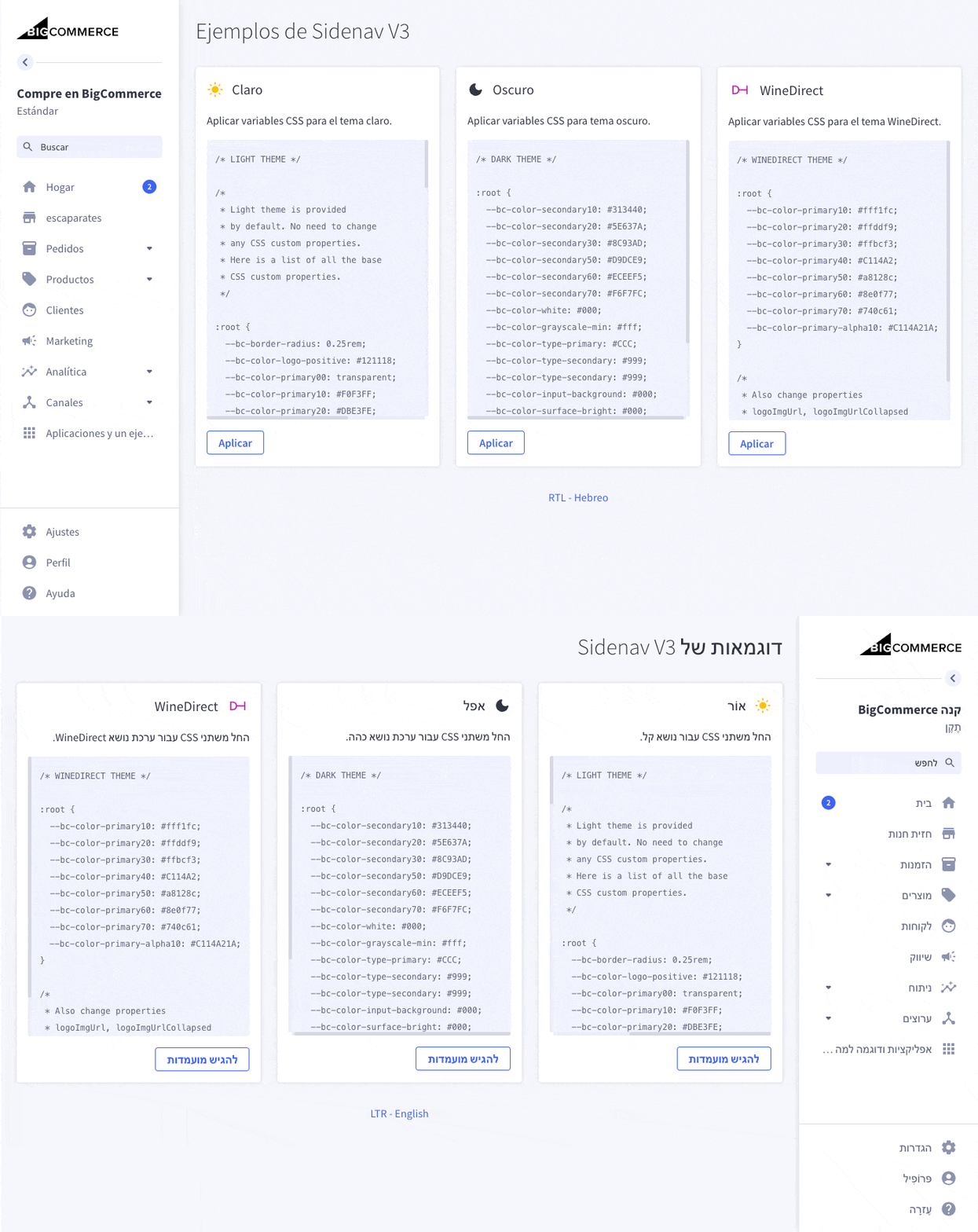
We built a coded, extensible prototype — including support for theming, white-labeling, and RTL — and used it to win leadership support for the redesign.
2. simplified settings
One of the clearest pain points was settings IA. Merchants were confused by the overlap between “settings,” “store,” and “storefront,” with no clear structure connecting them. User interviews and card sorting revealed a much simpler mental model, which led us to consolidate scattered destinations into a single categorized settings page with clearer labels and search.
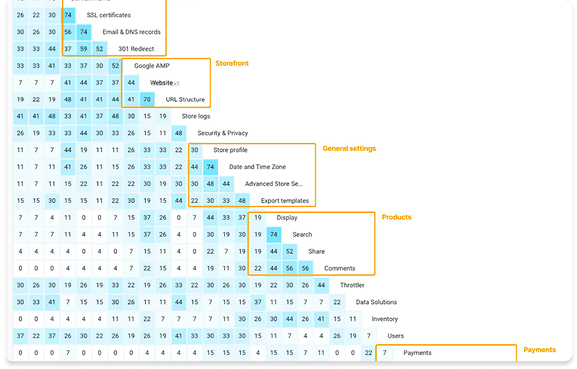
User interviews and card sorting showed that merchants grouped settings into a few clear categories — far simpler than our existing IA.
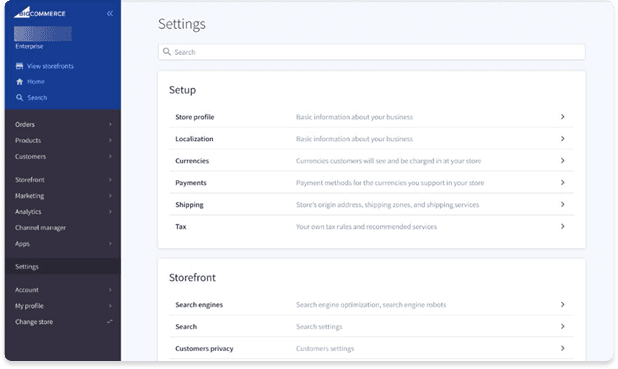
We consolidated scattered settings into a single page with clearer labels and search, removing major friction and creating a stronger foundation for the redesign.
We consolidated scattered settings into a single page with clearer labels and search, removing major friction and creating a stronger foundation for the redesign.
3. Tested navigation model with users
We knew the navigation needed more than visual cleanup. Core tasks and utilities were competing for the same space, making wayfinding harder. Because this was such a visible and high-impact change, I directed the team explore multiple models and validate them with users before committing to a direction.
We built and tested two coded versions of the experience — one with a top bar and one without. Testing showed that separating utilities like search, help, and notifications from core navigation made the product easier to understand, and that model became the foundation of the redesign.
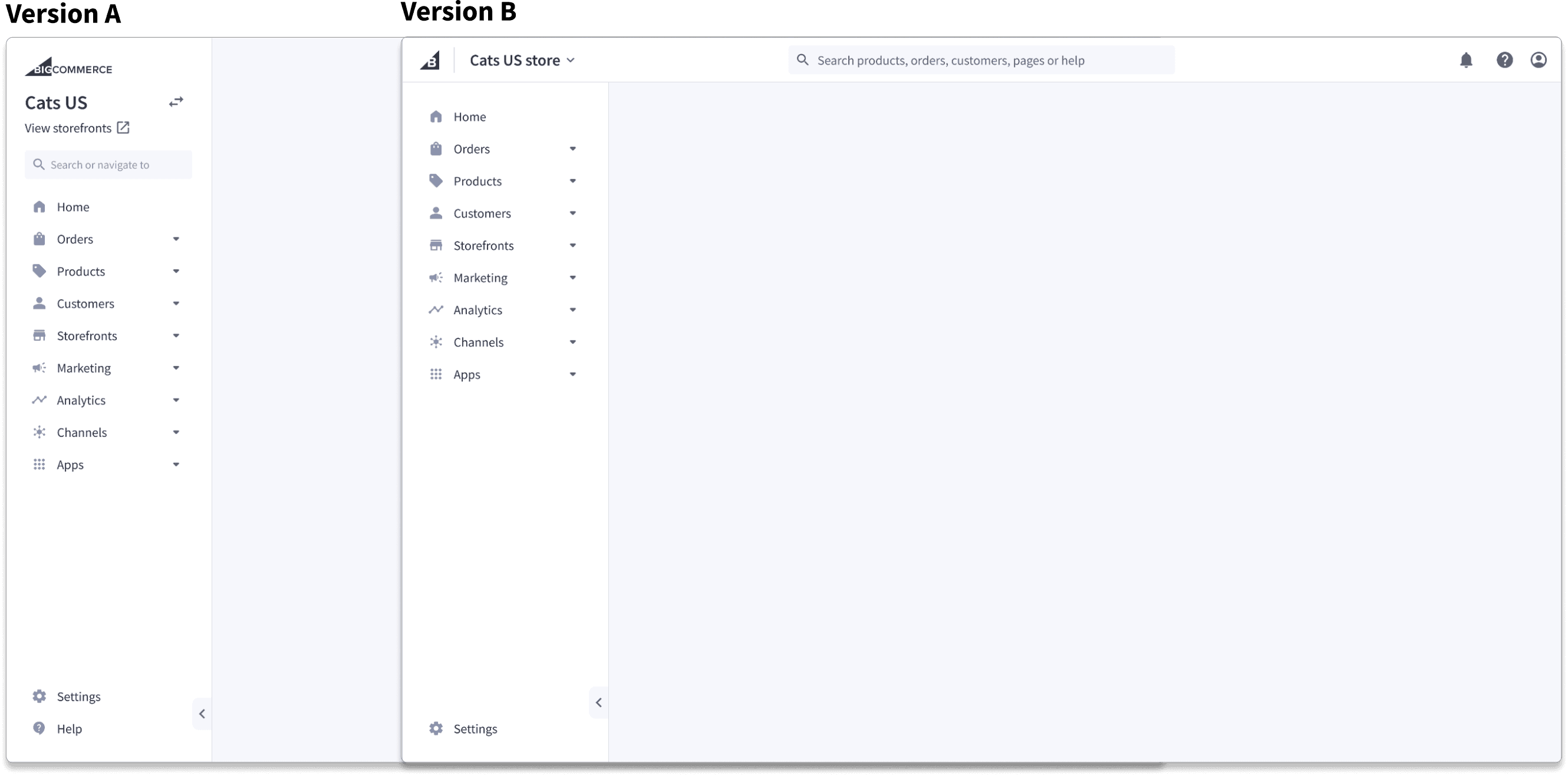
We tested two prototypes with users to select a design with a top bar separating utilities from navigation.
polishED, iterated and rolled out the experience
Once the model was clear, we focused on landing it well. We refined interaction details, upgraded visual polish, aligned the work to system standards, and personally negotiated with the TD Bank stakeholder team to retain the co-branded legacy experience without compromising the core design. We then rolled the redesign out in phases, using a guided tour, short-term opt-out feedback, and fast iteration—including a nav-only dark mode response—to build trust and reach a smooth 100% migration.
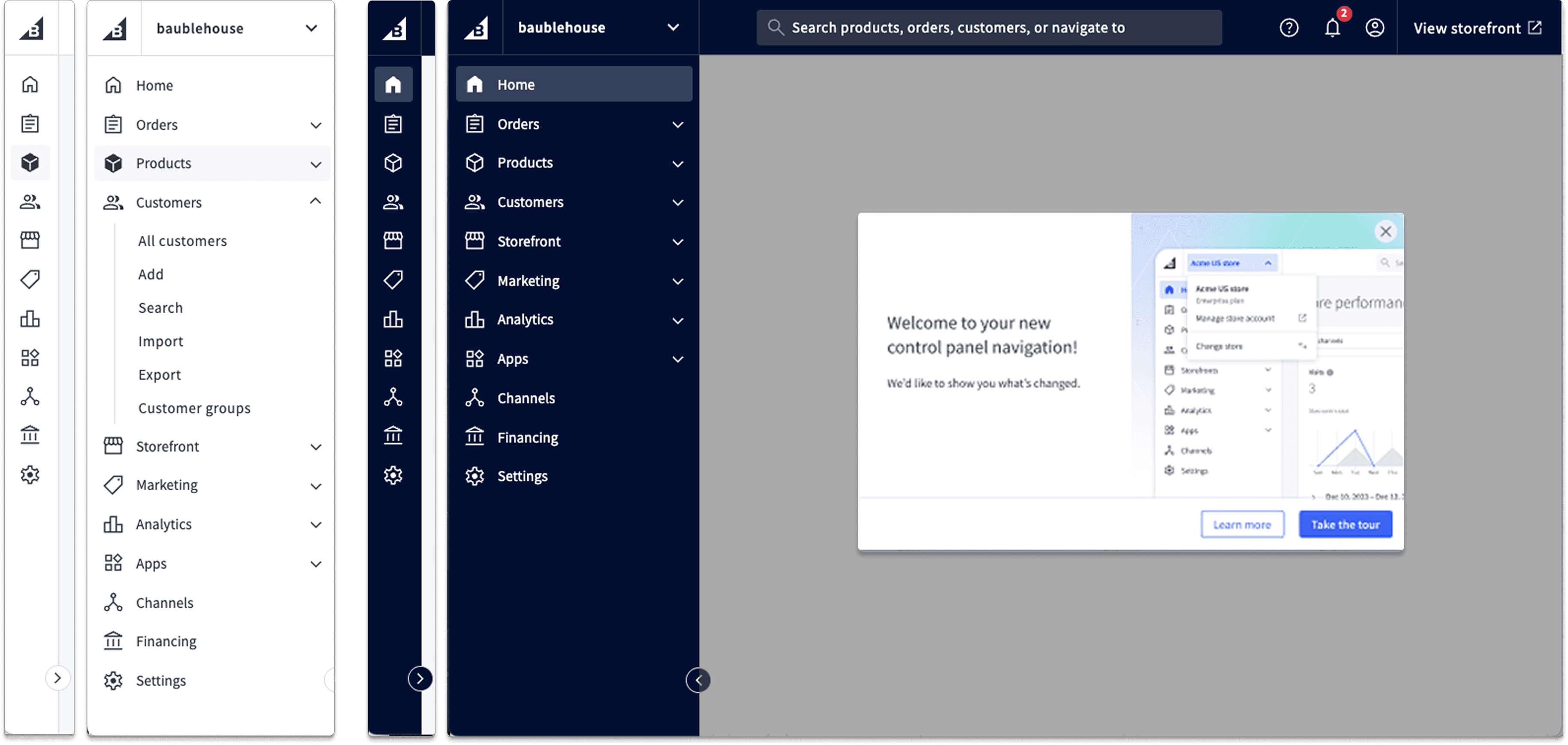
We refined the experience through polish, standards alignment, and customer feedback, then used guided migration to reach 100% adoption of the new navigation.
outcomes
The result was more than a better interface—we created a more trusted system for building product quality: clearer ownership, stronger standards, better reuse, and a major admin surface that shipped, scaled, and fully migrated.
Because we were so focused on iterating with customers all along the way and had documentation of this, we were able to secure our first ISO 9001 quality certification because of the evidence and strong proof of iteration towards user pain points.
Customers who stayed in to CP beta
0%
0%
User adoption of new control panel
0%
0%
Users impacted by control panel redesign
70k
70k
Reduction in related support tickets
0%
0%
learnings
The biggest unlock was making quality understandable to people outside the design team. By tying Platform Design to Developer Experience, framing UX debt in language Engineering could act on, and showing up with a coded prototype rather than a proposal, I was able to earn broader support for platform-wide changes inside a feature-shipping culture.
My biggest learning: organizational change doesn't wait for formal permission. If you have a clear vision, visible proof, and the willingness to go first — that's often enough to create the momentum leadership needs to act.
Platform design
Complex workflows
Quality at scale
Global commerce
Establishing Platform Quality at Scale
Company
BigCommerce
Role
Director of Product Design
Scope
Platform design, UX quality, Navigation
Year
2024–2025
Platform inconsistency had become a business risk at BigCommerce, but it kept losing out to feature work.
I built the case, founded a new function, secured resource commitments from the CPO and VP Engineering, and led a team to revamp the design building blocks into an Enterprise grade system.
This foundation allowed us to launch improvements to dozens of features and products across the platform, with the Control Panel used by 120K+ merchants as one of my favorite examples.
After 6 months of focused effort, we turned BigDesign, our design system, into a source of truth; for the first time we had a trusted, actively maintained system with clear ownership and governance that designers understood and developers bought into. This fueled improvements to dozens of product releases across our platform, including a redesign of our Control Panel navigation and core experience.
After 6 months of focused effort, we turned BigDesign, our design system, into a source of truth; for the first time we had a trusted, actively maintained system with clear ownership and governance that designers understood and developers bought into.
The CHALLENGE
BigCommerce's admin platform had grown through years of fast feature delivery across 20+ independent product teams. Our design system, BigDesign, lacked clear ownership and adoption. Core surfaces like navigation, settings, and utilities had accumulated years of debt, and there was no shared definition of quality to hold teams accountable.
Fragmentation was showing up in NPS feedback, support tickets, and partner escalations. As BigCommerce moved upmarket, this became a business risk. Enterprise merchants, partners, and internal teams needed a platform that felt coherent, trustworthy, and scalable.
The real challenge wasn't fixing the design system. It was changing how an entire organization — Product, Engineering, and Design across 20+ domains — thought about and executed with quality.
approach
I approached this as an organizational change problem, not a design execution one.
1. Established Craft as a Source of Truth I formalized Platform Design as a new function and directed the team to build a unified source of truth — refreshed Figma libraries, a data visualization guide, and comprehensive pattern documentation. To institutionalize this, I updated the Definition of Done to require design reviews and system adherence, shifting the culture from rapid output to systemic coherence.
2. Built a Shared Language for Quality I anchored Platform Design to Developer Experience — a high-priority domain with GTM goals — to secure engineering resources and credibility. I defined UX quality, launched a UX debt program, and ran systematic audits logging 700+ issues. This shared language across the org provided the rigorous documentation needed to earn BigCommerce's first ISO 9001 certification.
3. Built Visible Proof of Change To create momentum, I leveraged a design-engineering hackathon to tackle Control Panel navigation, a long-standing merchant pain point, and turned it into a high-visibility coded prototype. That visible proof of concept became the catalyst for securing leadership support for a full platform redesign.
60-70% platform was outdated
NPS feedback revealed user frustration.
Our audit revealed that 60% of the pages and 75% of our page views on our platform were old, outdated legacy patterns, not matching the rest of the platform.
“Every time…it downloads in a different manner, I can hear the the gears of my brain grinding, maintaining consistency across page to page to page.”
David, E-commerce Manager
BigCommerce customer
products: before & after platform design
The app installation landing page was upgraded to align with the new pattern library and guidelines.
The app installation landing page was upgraded to align with the new pattern library and guidelines.
The developer portal was redesigned using the BigDesign library to support the Open SaaS strategy.
Control panel navigation was redesigned with adherence to BigDesign to create a consistent, modern experience.
(Wireframes only) Before we had three different table styles with different behaviors. After we unified styles and behaviors utilizing a side panel, to address the need for a consistent view of table data.
results
The results were both organizational and measurable. Design went from advocating for quality to being part of how quality was defined and enforced — teams had shared language, clearer ownership, less rework, and stronger trust in cross-team delivery.
Within 6–12 months, using BigDesign shifted from "nice to have" to a trusted necessity across the org:
Published ~30 patterns and ~50 components for BigDesign; 40 components and 40 page templates for Catalyst storefronts
~90% BigDesign adoption across shipped products
~20% improvement in developer efficiency for common front-end patterns
Logged 700+ UX debt issues, resolved ~290 — establishing a baseline and a repeatable system for continuous improvement
2,500+ guide and pattern downloads via Figma Community
The Control Panel redesign was the clearest proof of this work at scale — a full release executed consistently across 30+ features using shared patterns and foundations, with measurable reduction in related customer support calls.
There were improvements to what we shipped, but also the change was cultural. Teams now had a shared language for quality, clearer ownership, less rework and higher trust in cross-team delivery - and the design team had more control of the work we did, thus more pride.
In ~6-12 months, using the BigDesign library shifted from “nice to have” to a trusted necessity.
Published ~30 patterns, ~50 components for BigDesign; 40 components, 40 page templates for Catalyst storefronts.
~20% improvement in developer efficiency for common front-end patterns
~90% adoption of BigDesign across shipped products (BigDesign usage in new releases)
We logged 700+ UX debt issues and resolved ~290, creating a baseline and a repeatable system for continuous improvement.
2,500+ guide & pattern downloads via Figma Community
We enabled consistent execution into the wild across 30+ releases/features using shared patterns and foundations.
The Control Panel redesign was the best example of this work coming to fruition: We released a high-quality product that adhered to our quality guidelines.
1: Made Craft a source of truth
Before teams could ship more consistently, shared patterns and quality decisions needed real ownership.
I decided to invest in foundational work instead of treating design systems as side work. Rather than wait for formal permission, I pulled together several designers to define a vision, align the team around it, and drive momentum around it.
vision & alignment docs
vision & alignment docs
We defined what a true source of truth needed to include — from components and patterns to principles and code standards — so the work could scale beyond a library alone.
We used OKRs as the way to drive to our platform-quality goals.
We defined what a true source of truth needed to include — from components and patterns to principles and code standards — so the work could scale beyond a library alone.
We used OKRs as the way to drive to our platform-quality goals.
design assets & building blocks we created
These are some of the patterns, principles, and supporting assets we as a team created as a first step. This process got everyone aligned on better craft and building more consistently across the product.
UX Quality & DEBT
We went beyond just the platform design work to redefine “quality” to include usefulness, usability, consistency and desirability and shared this with our Product and Engineering counterparts.
Some of the efforts we invested in:
Created a shared defintion of UX quality; aligned Product & Engineering
Running audits of over 40 pages in the platform and created 700+ issues in Jira
Creating a UX debt audit & Jira tracking system so teams could audit, prioritize and fix issues.
Created a GPT copy bot to apply copy guidelines.
We defined what a true source of truth needed to include — from components and patterns to principles and code standards — so the work could scale beyond a library alone.
AI BigDesign Copywriter: Since much of the UX debt we found was copy-related, we created a GPT writing assistant grounded in our UX writing guidelines.
UX Quality & DEBT
We went beyond just the platform design work to redefine “quality” to include usefulness, usability, consistency and desirability and shared this with our Product and Engineering counterparts.
Some of the efforts we invested in:
Created a shared definition of UX quality; aligned Product & Engineering
Running audits of over 40 pages in the platform and created 700+ issues in Jira
Creating a UX debt audit & Jira tracking system so teams could audit, prioritize and fix issues.
Created a GPT copy bot to apply copy guidelines.
We defined what a true source of truth needed to include — from components and patterns to principles and code standards — so the work could scale beyond a library alone.
AI BigDesign Copywriter: Since much of the UX debt we found was copy-related, we created a GPT writing assistant grounded in our UX writing guidelines.
results of ux quality work
UX debt issues logged after audits
0
0
UX debt issues resolved
0
0
UX debt issues logged after audits
0
0
UX debt issues resolved
0
0
2: Getting organizational buy-in
To make Platform Design real, I needed the org to see its importance. I paired Platform Design with Developer Experience — a domain with executive attention, resources, and a GTM mandate. That positioning unlocked a direct commitment from Product and Engineering leadership: four engineering stewards dedicated full-time to reinforcing pattern adoption across teams.
Formalizing this structure sent a clear signal: teams were expected to work through Platform Design rather than continue shipping one-off solutions. It gave the designers on my team the authority they needed — and gave the broader org a shared model for how quality gets built and maintained at scale.
We launched BigDesign as part of our Developer center, with Figma community links and external facing resources.
External facing pattern playground.
results of established platform design team
results of established platform design team
Asset downloads in Figma Community
Asset downloads in Figma Community
0
0
Improvement to developer efficiency
Improvement to developer efficiency
0%
0%
BigDesign adoption across shipped products
BigDesign adoption across shipped products
60%
60%
Released products & features using new patterns
15+
15+
3: LEveled up our execution
Control Panel as proof
Although there were many products we impacted, the Control Panel redesign became the clearest proof that Platform Design could influence real product outcomes. applied stronger standards, were able to develop a clearer information architecture, and implemented user-centered iteration where it mattered - on one of the most heavily used parts of the merchant experience.
support for the redesign through hackathon
The Control Panel had long been a daily pain point for merchants, but it kept losing priority to feature work. A design-engineering hackathon created an opening: we prototyped a new navigation model, built it as a coded and extensible vision, and used that work to win leadership attention and secure support for a redesign.
We built a coded, extensible prototype — including support for theming, white-labeling, and RTL — and used it to win leadership support for the redesign.
2. simplified settings
One of the clearest pain points was settings IA. Merchants were confused by the overlap between “settings,” “store,” and “storefront,” with no clear structure connecting them. User interviews and card sorting revealed a much simpler mental model, which led us to consolidate scattered destinations into a single categorized settings page with clearer labels and search.
User interviews and card sorting showed that merchants grouped settings into a few clear categories — far simpler than our existing IA.
We consolidated scattered settings into a single page with clearer labels and search, removing major friction and creating a stronger foundation for the redesign.
We consolidated scattered settings into a single page with clearer labels and search, removing major friction and creating a stronger foundation for the redesign.
3. Tested navigation model with users
We knew the navigation needed more than visual cleanup. Core tasks and utilities were competing for the same space, making wayfinding harder. Because this was such a visible and high-impact change, I directed the team explore multiple models and validate them with users before committing to a direction.
We built and tested two coded versions of the experience — one with a top bar and one without. Testing showed that separating utilities like search, help, and notifications from core navigation made the product easier to understand, and that model became the foundation of the redesign.
We tested two prototypes with users to select a design with a top bar separating utilities from navigation.
polishED, iterated and rolled out the experience
Once the model was clear, we focused on landing it well. We refined interaction details, upgraded visual polish, aligned the work to system standards, and personally negotiated with the TD Bank stakeholder team to retain the co-branded legacy experience without compromising the core design. We then rolled the redesign out in phases, using a guided tour, short-term opt-out feedback, and fast iteration—including a nav-only dark mode response—to build trust and reach a smooth 100% migration.
We refined the experience through polish, standards alignment, and customer feedback, then used guided migration to reach 100% adoption of the new navigation.
outcomes
The result was more than a better interface—we created a more trusted system for building product quality: clearer ownership, stronger standards, better reuse, and a major admin surface that shipped, scaled, and fully migrated.
Because we were so focused on iterating with customers all along the way and had documentation of this, we were able to secure our first ISO 9001 quality certification because of the evidence and strong proof of iteration towards user pain points.
Customers who stayed in to CP beta
0%
0%
User adoption of new control panel
0%
0%
Users impacted by control panel redesign
70k
70k
Reduction in related support tickets
0%
0%
learnings
The biggest unlock was making quality understandable to people outside the design team. By tying Platform Design to Developer Experience, framing UX debt in language Engineering could act on, and showing up with a coded prototype rather than a proposal, I was able to earn broader support for platform-wide changes inside a feature-shipping culture.
My biggest learning: organizational change doesn't wait for formal permission. If you have a clear vision, visible proof, and the willingness to go first — that's often enough to create the momentum leadership needs to act.
Platform design
Complex workflows
Quality at scale
Global commerce
Establishing Platform Quality at Scale
Company
BigCommerce
Role
Director of Product Design
Scope
Platform design, UX quality, Navigation
Year
2024–2025
Platform inconsistency had become a business risk at BigCommerce, but it kept losing out to feature work.
I built the case, founded a new function, secured resource commitments from the CPO and VP Engineering, and led a team to revamp the design building blocks into an Enterprise grade system.
This foundation allowed us to launch improvements to dozens of features and products across the platform, with the Control Panel used by 120K+ merchants as one of my favorite examples.
After 6 months of focused effort, we turned BigDesign, our design system, into a source of truth; for the first time we had a trusted, actively maintained system with clear ownership and governance that designers understood and developers bought into. This fueled improvements to dozens of product releases across our platform, including a redesign of our Control Panel navigation and core experience.
After 6 months of focused effort, we turned BigDesign, our design system, into a source of truth; for the first time we had a trusted, actively maintained system with clear ownership and governance that designers understood and developers bought into.
The CHALLENGE
BigCommerce's admin platform had grown through years of fast feature delivery across 20+ independent product teams. Our design system, BigDesign, lacked clear ownership and adoption. Core surfaces like navigation, settings, and utilities had accumulated years of debt, and there was no shared definition of quality to hold teams accountable.
Fragmentation was showing up in NPS feedback, support tickets, and partner escalations. As BigCommerce moved upmarket, this became a business risk. Enterprise merchants, partners, and internal teams needed a platform that felt coherent, trustworthy, and scalable.
The real challenge wasn't fixing the design system. It was changing how an entire organization — Product, Engineering, and Design across 20+ domains — thought about and executed with quality.
approach
I approached this as an organizational change problem, not a design execution one.
1. Established Craft as a Source of Truth I formalized Platform Design as a new function and directed the team to build a unified source of truth — refreshed Figma libraries, a data visualization guide, and comprehensive pattern documentation. To institutionalize this, I updated the Definition of Done to require design reviews and system adherence, shifting the culture from rapid output to systemic coherence.
2. Built a Shared Language for Quality I anchored Platform Design to Developer Experience — a high-priority domain with GTM goals — to secure engineering resources and credibility. I defined UX quality, launched a UX debt program, and ran systematic audits logging 700+ issues. This shared language across the org provided the rigorous documentation needed to earn BigCommerce's first ISO 9001 certification.
3. Built Visible Proof of Change To create momentum, I leveraged a design-engineering hackathon to tackle Control Panel navigation, a long-standing merchant pain point, and turned it into a high-visibility coded prototype. That visible proof of concept became the catalyst for securing leadership support for a full platform redesign.
60-70% platform was outdated
NPS feedback revealed user frustration.
Our audit revealed that 60% of the pages and 75% of our page views on our platform were old, outdated legacy patterns, not matching the rest of the platform.
“Every time…it downloads in a different manner, I can hear the the gears of my brain grinding, maintaining consistency across page to page to page.”
David, E-commerce Manager
BigCommerce customer
products: before & after platform design
The app installation landing page was upgraded to align with the new pattern library and guidelines.
The app installation landing page was upgraded to align with the new pattern library and guidelines.
The developer portal was redesigned using the BigDesign library to support the Open SaaS strategy.
Control panel navigation was redesigned with adherence to BigDesign to create a consistent, modern experience.
(Wireframes only) Before we had three different table styles with different behaviors. After we unified styles and behaviors utilizing a side panel, to address the need for a consistent view of table data.
results
The results were both organizational and measurable. Design went from advocating for quality to being part of how quality was defined and enforced — teams had shared language, clearer ownership, less rework, and stronger trust in cross-team delivery.
Within 6–12 months, using BigDesign shifted from "nice to have" to a trusted necessity across the org:
Published ~30 patterns and ~50 components for BigDesign; 40 components and 40 page templates for Catalyst storefronts
~90% BigDesign adoption across shipped products
~20% improvement in developer efficiency for common front-end patterns
Logged 700+ UX debt issues, resolved ~290 — establishing a baseline and a repeatable system for continuous improvement
2,500+ guide and pattern downloads via Figma Community
The Control Panel redesign was the clearest proof of this work at scale — a full release executed consistently across 30+ features using shared patterns and foundations, with measurable reduction in related customer support calls.
There were improvements to what we shipped, but also the change was cultural. Teams now had a shared language for quality, clearer ownership, less rework and higher trust in cross-team delivery - and the design team had more control of the work we did, thus more pride.
In ~6-12 months, using the BigDesign library shifted from “nice to have” to a trusted necessity.
Published ~30 patterns, ~50 components for BigDesign; 40 components, 40 page templates for Catalyst storefronts.
~20% improvement in developer efficiency for common front-end patterns
~90% adoption of BigDesign across shipped products (BigDesign usage in new releases)
We logged 700+ UX debt issues and resolved ~290, creating a baseline and a repeatable system for continuous improvement.
2,500+ guide & pattern downloads via Figma Community
We enabled consistent execution into the wild across 30+ releases/features using shared patterns and foundations.
The Control Panel redesign was the best example of this work coming to fruition: We released a high-quality product that adhered to our quality guidelines.
1: Made Craft a source of truth
Before teams could ship more consistently, shared patterns and quality decisions needed real ownership.
I decided to invest in foundational work instead of treating design systems as side work. Rather than wait for formal permission, I pulled together several designers to define a vision, align the team around it, and drive momentum around it.
vision & alignment docs
vision & alignment docs
We defined what a true source of truth needed to include — from components and patterns to principles and code standards — so the work could scale beyond a library alone.
We used OKRs as the way to drive to our platform-quality goals.
We defined what a true source of truth needed to include — from components and patterns to principles and code standards — so the work could scale beyond a library alone.
We used OKRs as the way to drive to our platform-quality goals.
design assets & building blocks we created
These are some of the patterns, principles, and supporting assets we as a team created as a first step. This process got everyone aligned on better craft and building more consistently across the product.
UX Quality & DEBT
We went beyond just the platform design work to redefine “quality” to include usefulness, usability, consistency and desirability and shared this with our Product and Engineering counterparts.
Some of the efforts we invested in:
Created a shared defintion of UX quality; aligned Product & Engineering
Running audits of over 40 pages in the platform and created 700+ issues in Jira
Creating a UX debt audit & Jira tracking system so teams could audit, prioritize and fix issues.
Created a GPT copy bot to apply copy guidelines.
We defined what a true source of truth needed to include — from components and patterns to principles and code standards — so the work could scale beyond a library alone.
AI BigDesign Copywriter: Since much of the UX debt we found was copy-related, we created a GPT writing assistant grounded in our UX writing guidelines.
UX Quality & DEBT
We went beyond just the platform design work to redefine “quality” to include usefulness, usability, consistency and desirability and shared this with our Product and Engineering counterparts.
Some of the efforts we invested in:
Created a shared definition of UX quality; aligned Product & Engineering
Running audits of over 40 pages in the platform and created 700+ issues in Jira
Creating a UX debt audit & Jira tracking system so teams could audit, prioritize and fix issues.
Created a GPT copy bot to apply copy guidelines.
We defined what a true source of truth needed to include — from components and patterns to principles and code standards — so the work could scale beyond a library alone.
AI BigDesign Copywriter: Since much of the UX debt we found was copy-related, we created a GPT writing assistant grounded in our UX writing guidelines.
results of ux quality work
UX debt issues logged after audits
0
0
UX debt issues resolved
0
0
UX debt issues logged after audits
0
0
UX debt issues resolved
0
0
2: Getting organizational buy-in
To make Platform Design real, I needed the org to see its importance. I paired Platform Design with Developer Experience — a domain with executive attention, resources, and a GTM mandate. That positioning unlocked a direct commitment from Product and Engineering leadership: four engineering stewards dedicated full-time to reinforcing pattern adoption across teams.
Formalizing this structure sent a clear signal: teams were expected to work through Platform Design rather than continue shipping one-off solutions. It gave the designers on my team the authority they needed — and gave the broader org a shared model for how quality gets built and maintained at scale.
We launched BigDesign as part of our Developer center, with Figma community links and external facing resources.
External facing pattern playground.
results of established platform design team
results of established platform design team
Asset downloads in Figma Community
Asset downloads in Figma Community
0
0
Improvement to developer efficiency
Improvement to developer efficiency
0%
0%
BigDesign adoption across shipped products
BigDesign adoption across shipped products
60%
60%
Released products & features using new patterns
15+
15+
3: LEveled up our execution
Control Panel as proof
Although there were many products we impacted, the Control Panel redesign became the clearest proof that Platform Design could influence real product outcomes. applied stronger standards, were able to develop a clearer information architecture, and implemented user-centered iteration where it mattered - on one of the most heavily used parts of the merchant experience.
support for the redesign through hackathon
The Control Panel had long been a daily pain point for merchants, but it kept losing priority to feature work. A design-engineering hackathon created an opening: we prototyped a new navigation model, built it as a coded and extensible vision, and used that work to win leadership attention and secure support for a redesign.
We built a coded, extensible prototype — including support for theming, white-labeling, and RTL — and used it to win leadership support for the redesign.
2. simplified settings
One of the clearest pain points was settings IA. Merchants were confused by the overlap between “settings,” “store,” and “storefront,” with no clear structure connecting them. User interviews and card sorting revealed a much simpler mental model, which led us to consolidate scattered destinations into a single categorized settings page with clearer labels and search.
User interviews and card sorting showed that merchants grouped settings into a few clear categories — far simpler than our existing IA.
We consolidated scattered settings into a single page with clearer labels and search, removing major friction and creating a stronger foundation for the redesign.
We consolidated scattered settings into a single page with clearer labels and search, removing major friction and creating a stronger foundation for the redesign.
3. Tested navigation model with users
We knew the navigation needed more than visual cleanup. Core tasks and utilities were competing for the same space, making wayfinding harder. Because this was such a visible and high-impact change, I directed the team explore multiple models and validate them with users before committing to a direction.
We built and tested two coded versions of the experience — one with a top bar and one without. Testing showed that separating utilities like search, help, and notifications from core navigation made the product easier to understand, and that model became the foundation of the redesign.
We tested two prototypes with users to select a design with a top bar separating utilities from navigation.
polishED, iterated and rolled out the experience
Once the model was clear, we focused on landing it well. We refined interaction details, upgraded visual polish, aligned the work to system standards, and personally negotiated with the TD Bank stakeholder team to retain the co-branded legacy experience without compromising the core design. We then rolled the redesign out in phases, using a guided tour, short-term opt-out feedback, and fast iteration—including a nav-only dark mode response—to build trust and reach a smooth 100% migration.
We refined the experience through polish, standards alignment, and customer feedback, then used guided migration to reach 100% adoption of the new navigation.
outcomes
The result was more than a better interface—we created a more trusted system for building product quality: clearer ownership, stronger standards, better reuse, and a major admin surface that shipped, scaled, and fully migrated.
Because we were so focused on iterating with customers all along the way and had documentation of this, we were able to secure our first ISO 9001 quality certification because of the evidence and strong proof of iteration towards user pain points.
Customers who stayed in to CP beta
0%
0%
User adoption of new control panel
0%
0%
Users impacted by control panel redesign
70k
70k
Reduction in related support tickets
0%
0%
learnings
The biggest unlock was making quality understandable to people outside the design team. By tying Platform Design to Developer Experience, framing UX debt in language Engineering could act on, and showing up with a coded prototype rather than a proposal, I was able to earn broader support for platform-wide changes inside a feature-shipping culture.
My biggest learning: organizational change doesn't wait for formal permission. If you have a clear vision, visible proof, and the willingness to go first — that's often enough to create the momentum leadership needs to act.