AI / Emerging tech
Complex workflows
Org enablement
Global commerce
Creating an AI-ready product design organization
Company
BigCommerce
Role
Director / Senior Director Product Design
Scope
AI-enabled workflows, generative AI authoring, opportunity discovery
Year
2023-25
Helping a global commerce platform explore building AI-native product experiences and modernize internal design workflows during the rise of generative AI.
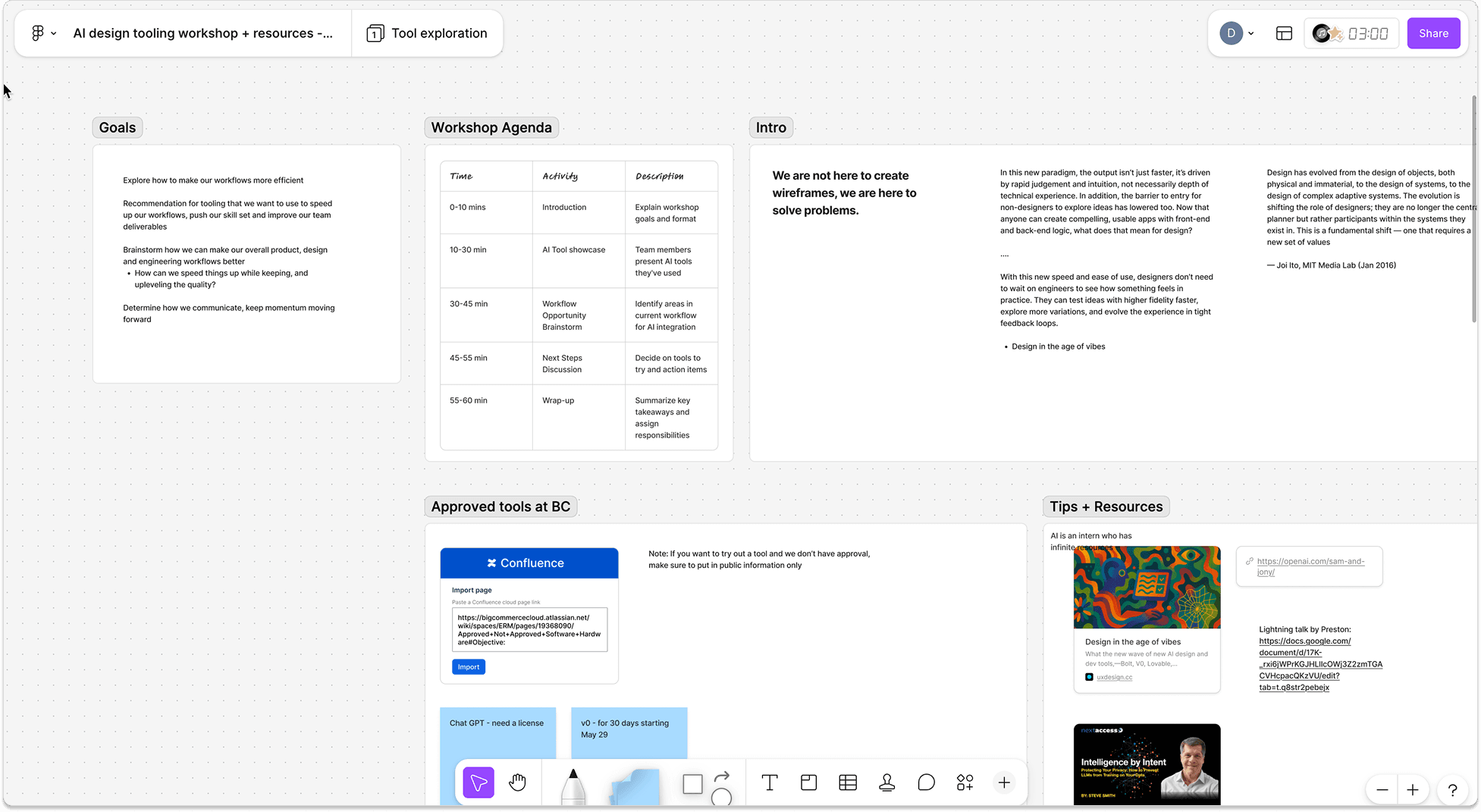
A FigJam board from a workshop where the team did screen shares of how they were working with AI. The goal of the workshop was to explore how to make our workflows more efficient, maintain quality and determine how we communicate and keep momentum on learning.
A FigJam board from a workshop where the team did screen shares of how they were working with AI. The goal of the workshop was to explore how to make our workflows more efficient, maintain quality and determine how we communicate and keep momentum on learning.
The moment
As generative AI rapidly reshaped software expectations, our organization faced a growing gap between AI excitement and operational readiness. Product teams lacked clear frameworks for how AI should fit into merchant workflows, while designers were navigating uncertainty around how AI would reshape their own practice.
As PMs and engineers began rapidly prototyping with AI tooling, many designers worried design would be left out. I saw the opportunity as one for design to reposition itself as a discipline responsible for shaping clarity, workflows, and trust in AI-native experiences.
my approach
1. Created Space for Exploration
Ran a 4-day Product Design Summit across four strategic pillars, generating 10–20 AI concepts — including a B2B quote generator and the seeds of BigAI Copywriter.
2. Used AI to Improve Discovery and Delivery
Expanded the team's capabilities on both ends — using AI to accelerate synthesis and journey mapping in research, and to maintain craft and consistency in design delivery.
3. launched ai-powered products
Helped bring BigAI Copywriter to market as a free standalone integration, helping merchants generate SEO-optimized product descriptions at scale.
4. evolved a shared practice
Drafted a cross-functional AI playbook covering principles, risks, and role evolution — giving Product, Design, and Engineering shared language and confident footing.
Leading through the AI shift
createD space for exploration
I ran a 4-day Product Design Summit to push the team into AI thinking. The goal was to bring forward AI concepts that reduced merchant friction across 4 of our strategic pillars: Storefronts, B2B, International and Product Catalog.
Outputs: 10–20 AI concepts that we used for many projects, including a new headless storefront, a B2B quote generator and the seeds of BigAI Copywriter, a generative AI product the team shipped to merchants in 2024.
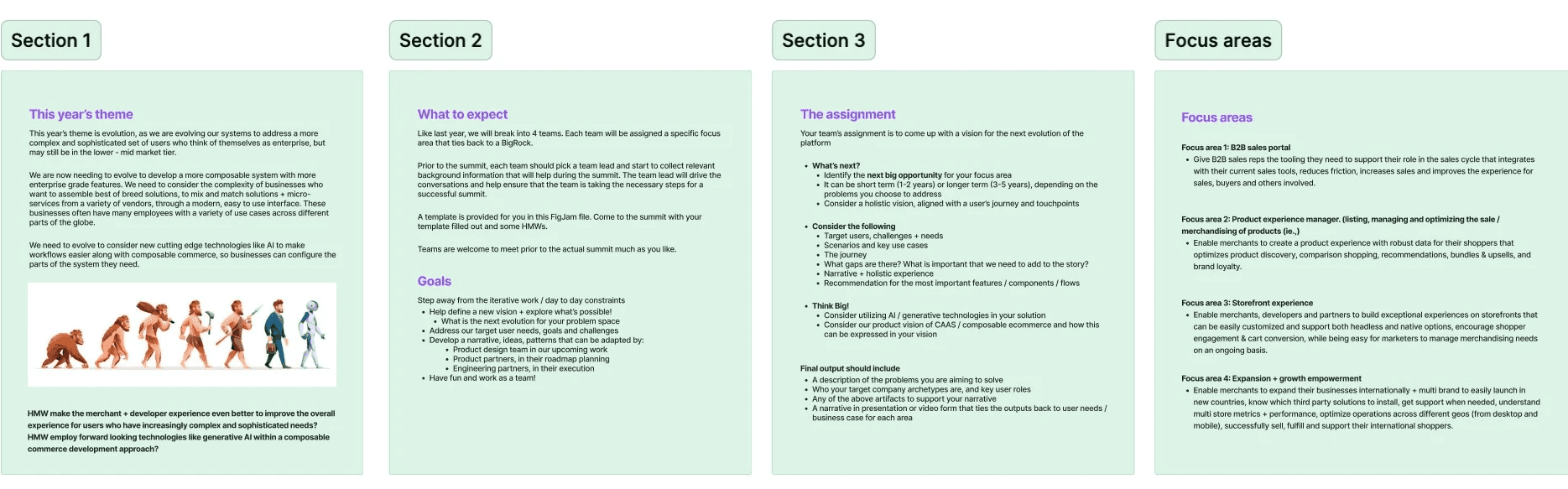
I organized the team into 4 groups for in-person work across geos. Each team started with a FigJam board that had prompts to explore AI for their specific strategic focus area based on known user needs - this was in 2023. The tools available to use were very different than today's, but we needed to identify next-gen applications in our products.
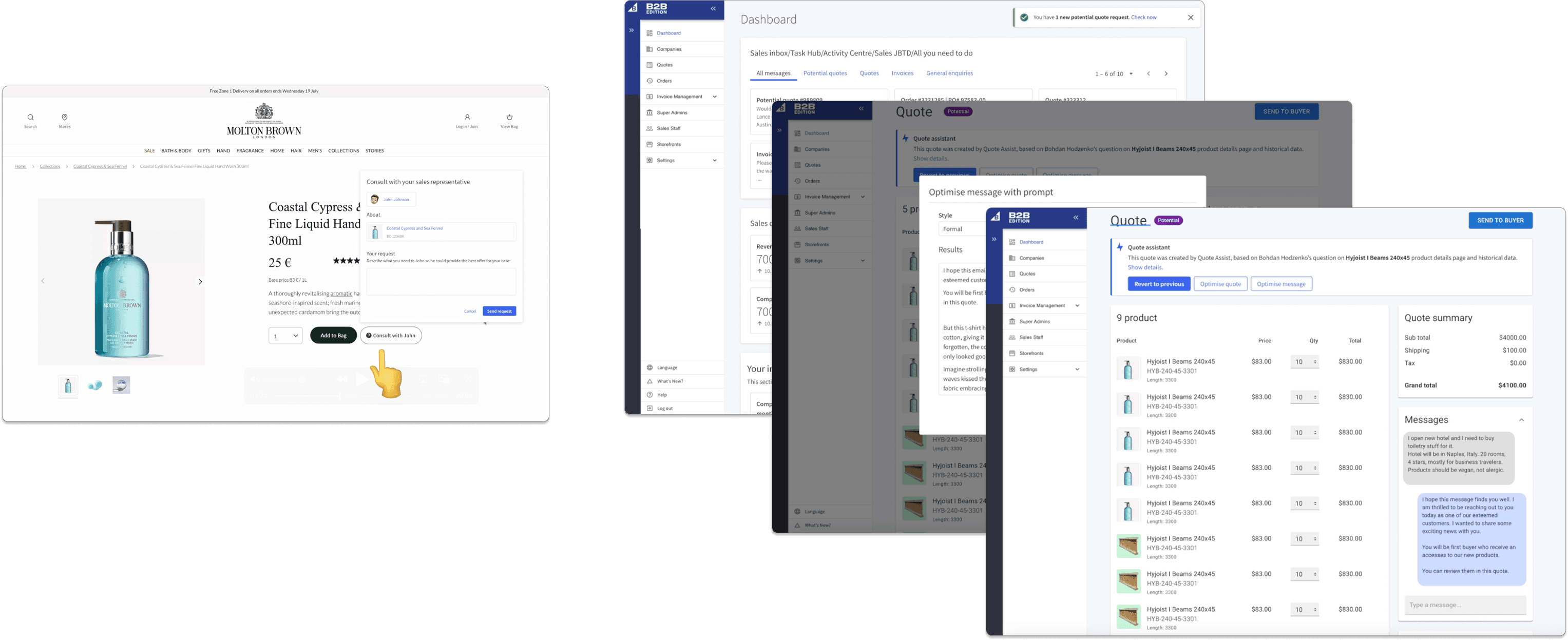
Some of the concepts that came out of the spring for an AI powered B2B quote generator. This was added to the product roadmap.
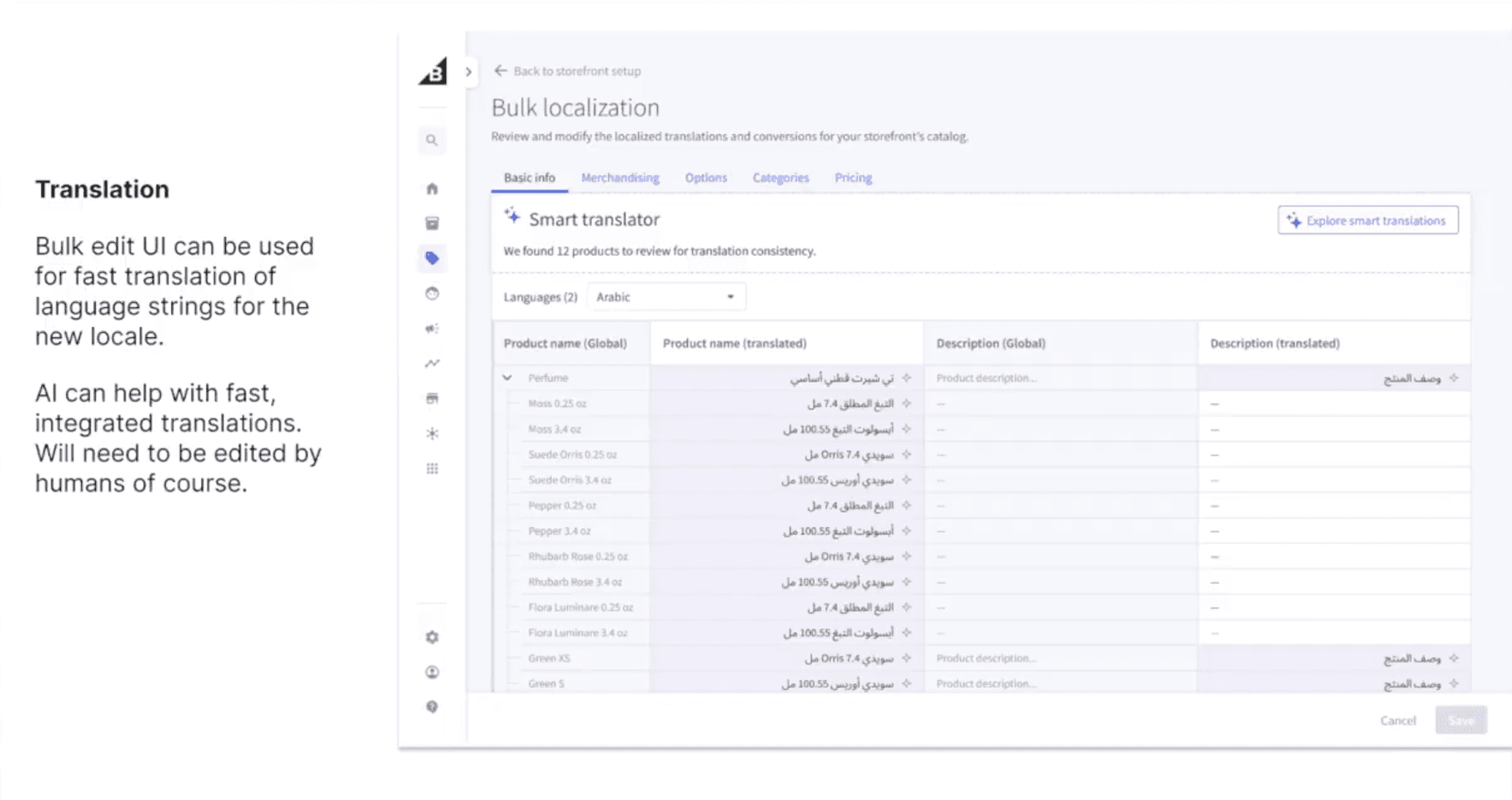
We came up with 10-15 solid ideas with AI capabilities. This concept that my breakout team created uses AI to handle product translations at scale. Our BigAI Copywriter, a product description generator which was launched in 2024 came out of these workshops.
USed AI to improve discovery and delivery
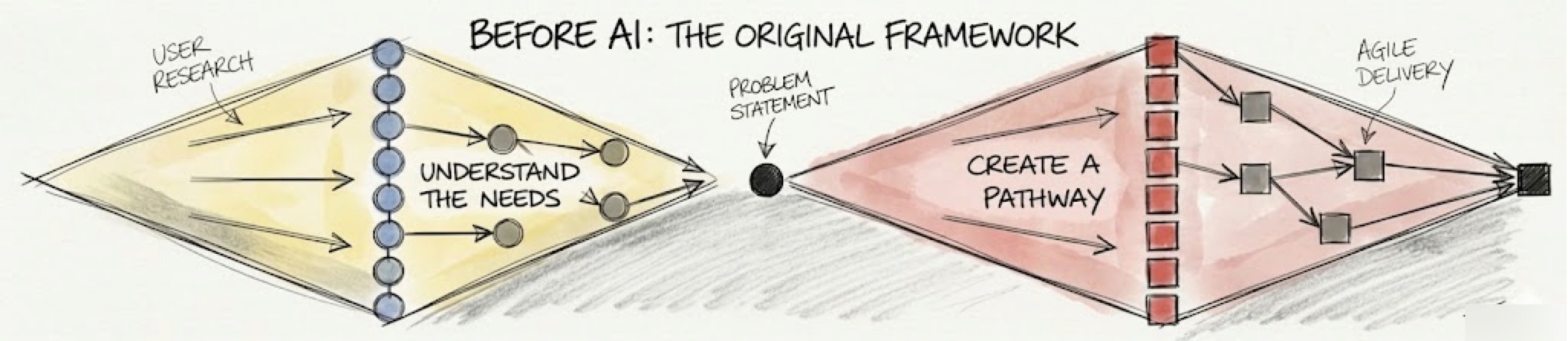
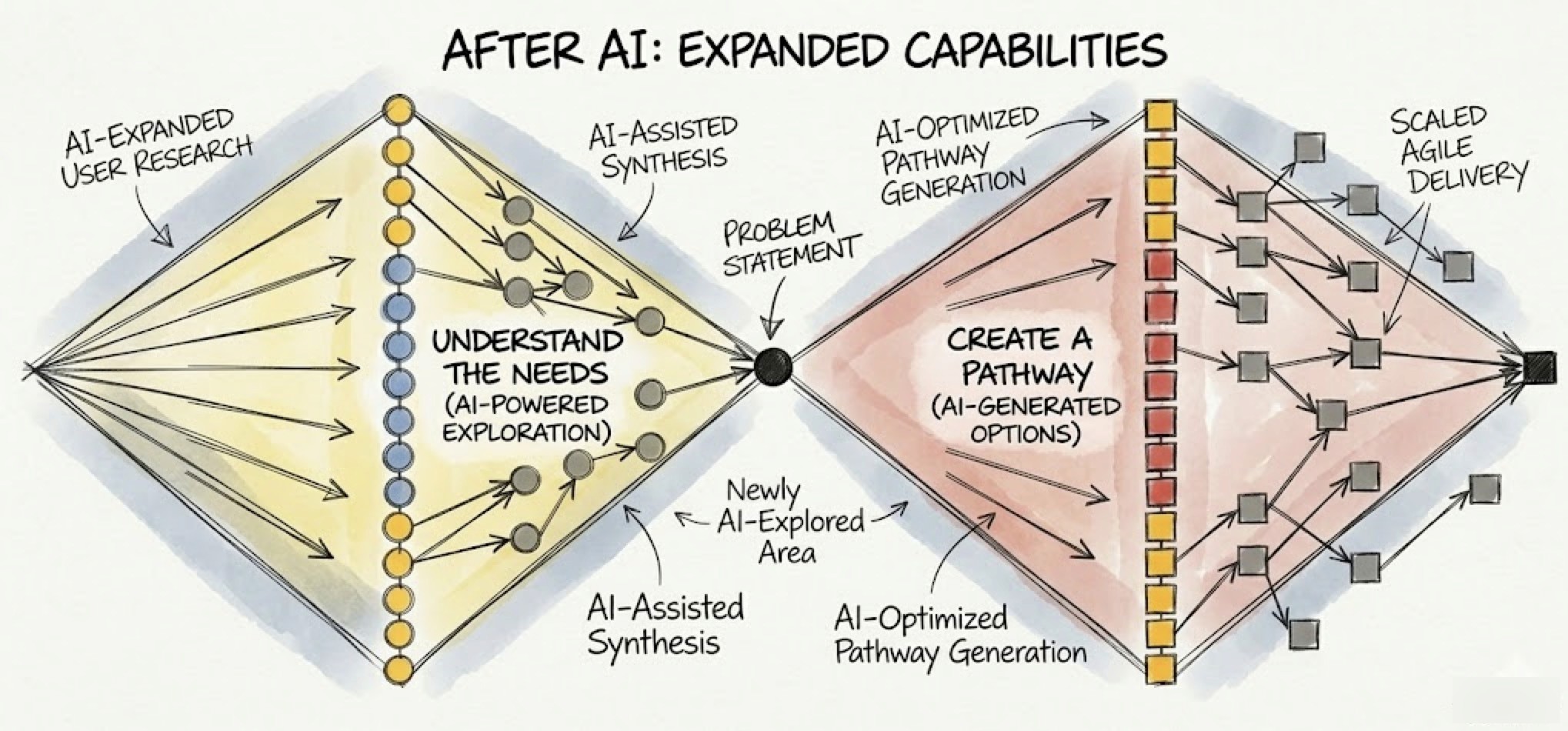
I strongly encouraged the team to use AI in their work. We realized that it could help the researchers with discovery and the designers with delivery. AI was expanding our abilities in each of these categories.
Ai as an expansion enabler
AI expanded both the speed and breadth of exploration across research, synthesis, prototyping, and delivery workflows.
examples: discovery

I used ChatGPT to map out high level steps of a merchant journey, based on conversations with sales and account managers. These were used in designing 0—>1 product experiences, including onbaording and the redesign of our Catalyst headless storefront experience.
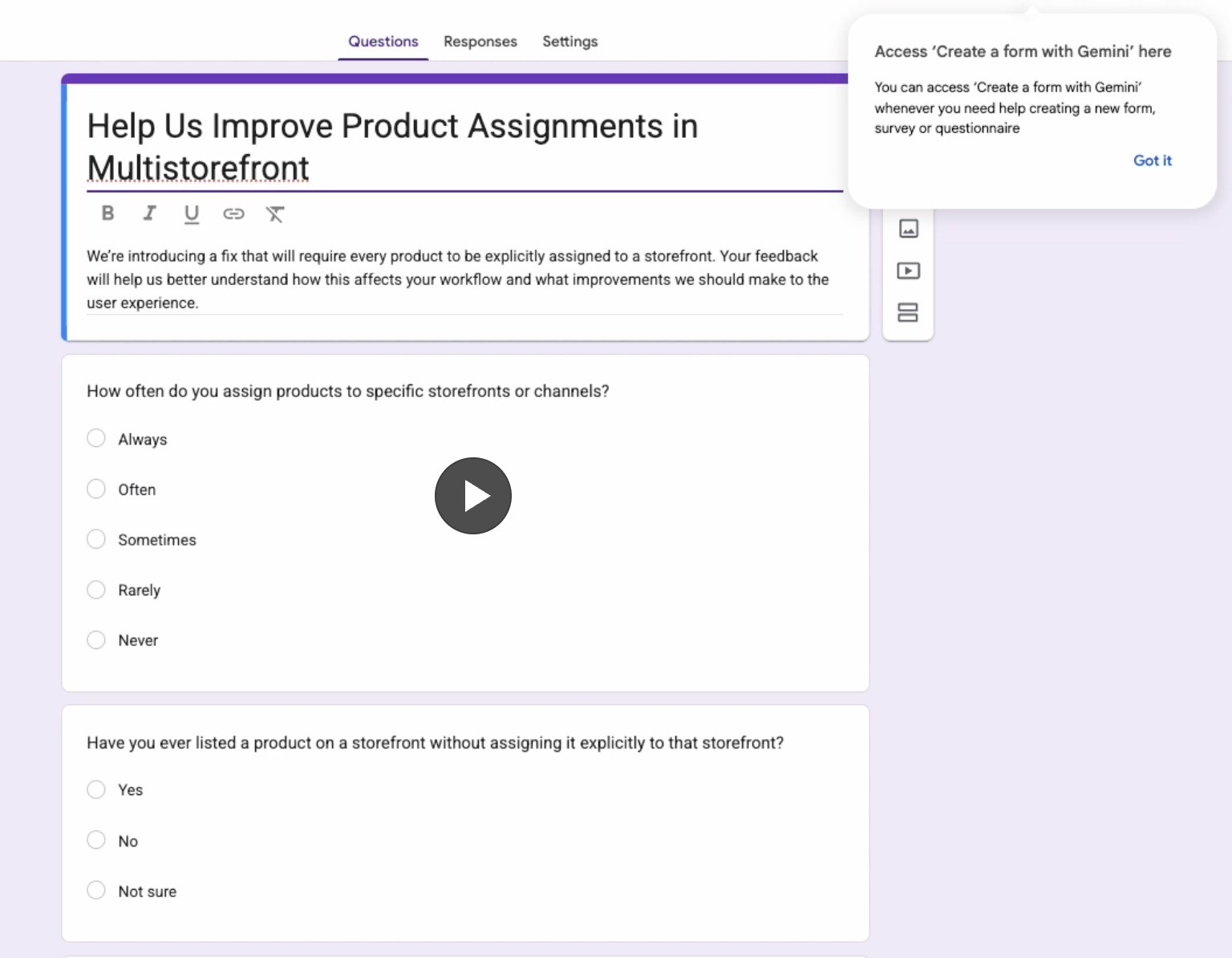
A non-English speaking product designer was able to create her own survey, with a research review first.
A product designer was able to create her own survey, with a research review first.
examples: delivery & craft
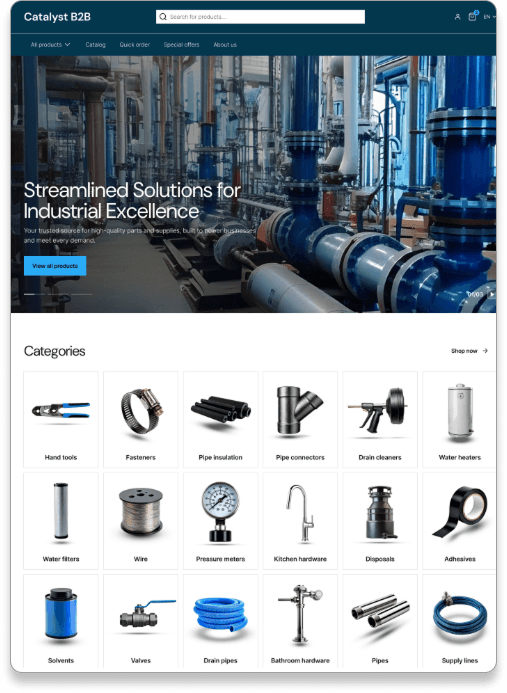
AI elevated our ability to craft images in a specific style for templates. We used AI generated product images from Adobe Firefly in an industrial 3D style to illustrate a B2B centric storefront template.

To maintain consistency across a multi-disciplinary team, we launched a GPT-powered writing assistant. It automated adherence to our style guide, ensuring the right tone and voice while significantly speeding up the drafting process.

We used Claude 3.5 to help brainstorm how to show unlimited inventory in backorders, and it surfaced the infinity symbol idea that we ended up using. It was a simple example of how AI can be genuinely useful in early design exploration, and even help with innovation.
launched ai-powered products
Bigai copywriter
In 2024, BigAI Copywriter became our first attempt to bring generative AI directly into the merchant experience. The goal was to reduce the friction of writing SEO-optimized product descriptions for large catalogs.
To move quickly, we launched v1 as a free standalone integration. A Senior Designer on my team led the design work with my guidance around workflow integration, AI interaction patterns, and long-term platform considerations.
The project surfaced deeper product and workflow questions:
Where should AI appear within the authoring flow?
How much merchant control should exist?
How do we preserve trust in generated outputs?
Should AI interactions be inline or separated?
How should prompts and brand context shape output quality?
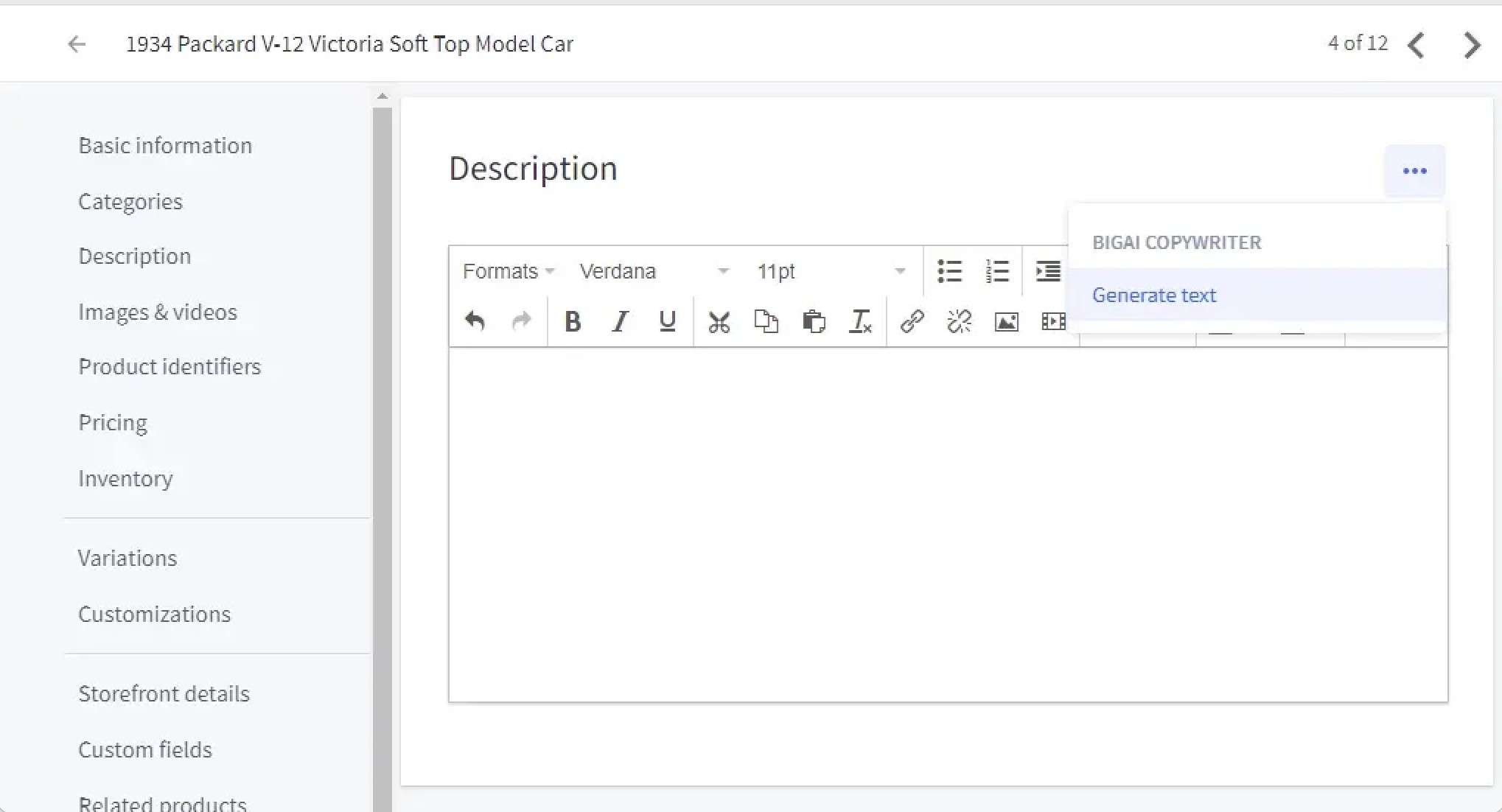
To launch quickly, BigAI copywriter was launched as an app that was accessible from product descriptions.
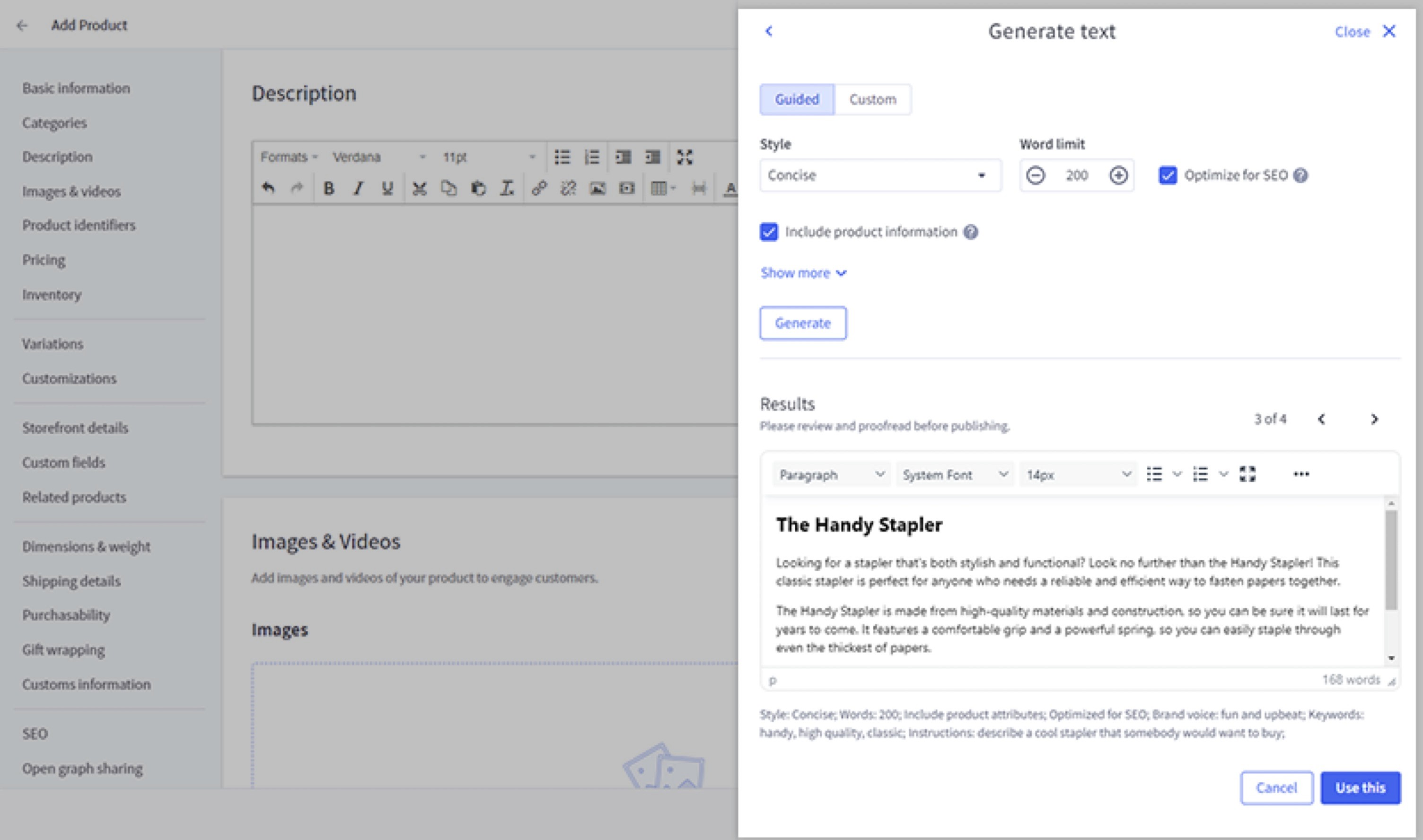
Building it as an app exposed platform challenges including compatibility with our Catalog v2 APIs, reusable brand context, multilingual support, tighter integration into existing workflows
One of the learnings was that AI works best when embedded directly into existing workflows rather than treated as a separate tool. While the standalone integration helped us validate demand quickly, it also introduced friction by separating generation from the natural catalog-authoring experience.
AI support experience
I helped push forward the idea of an embedded AI companion designed to guide merchants and developers through complex workflows like store setup and integrations. While the solution launched after I left BigCommerce, it grew out of earlier onboarding and support explorations my team had been driving.
The goal was to surface contextual guidance directly within the workflow, reducing the need for users to search across large amounts of documentation.
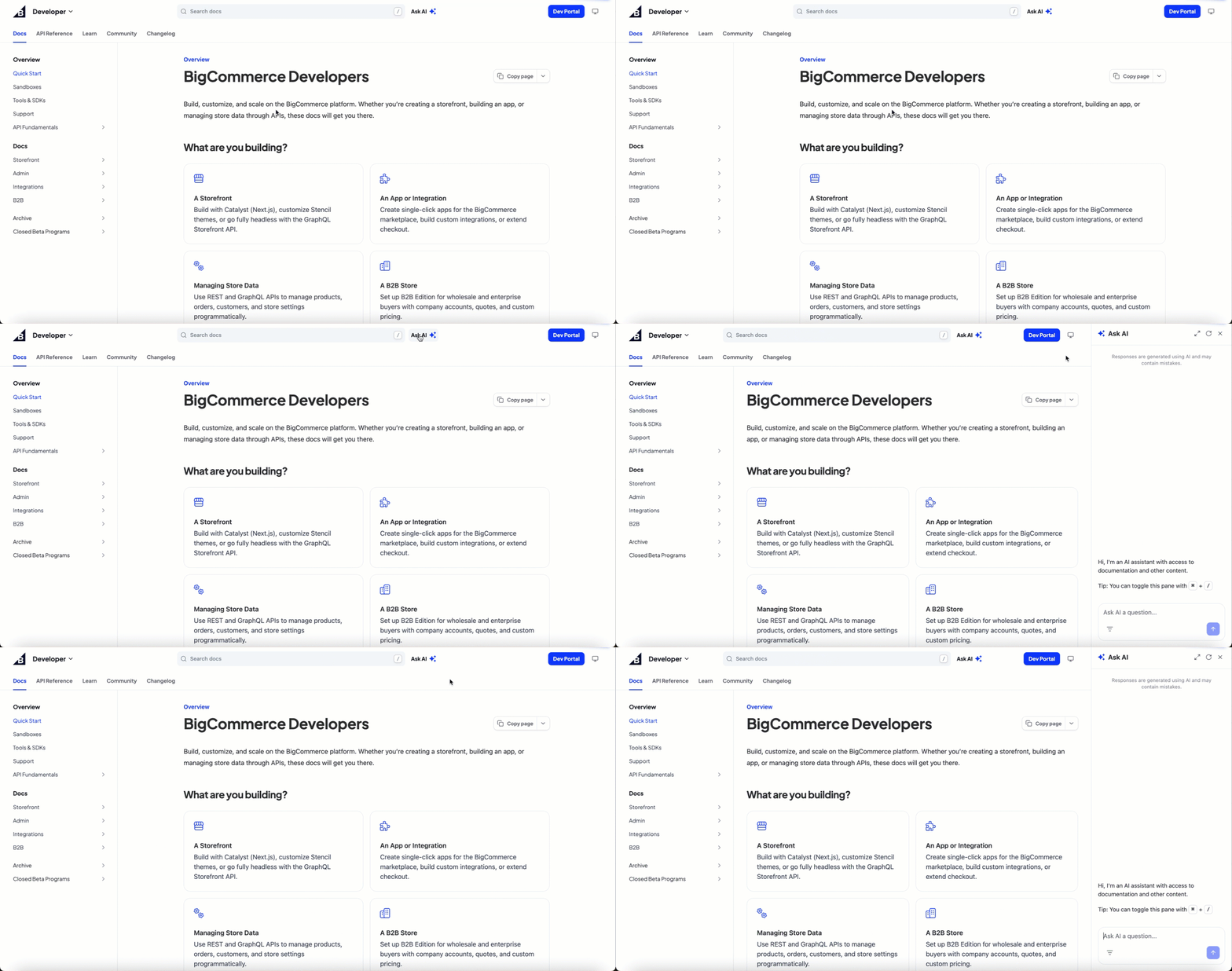
AI companion: We designed a slide out for an AI companion that opened and closed, with the content viewable rather than covering it, and a keystroke control. Although this launched after I left, I helped shape the concept.
evolved a shared practice
When PMs started creating their own prototypes in v0, the designers became confused about their roles. With the help of the team, I drafted a cross-functional AI playbook and defined principles, risks, role evolution, and where AI fit in our workflows. I shared it with our CPO and used it to give clarity to teams.
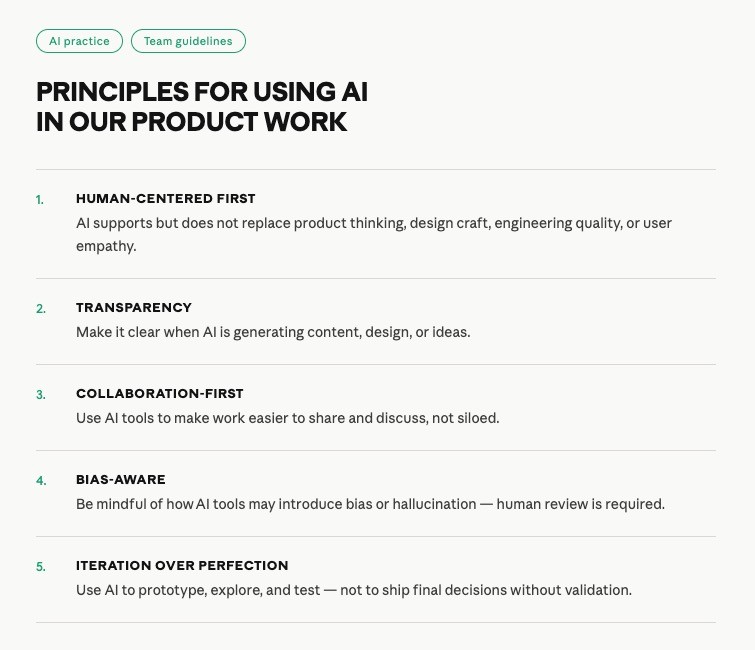
Principles to anchor experimentation in good judgment — making sure speed never came at the cost of craft, transparency, or user trust.
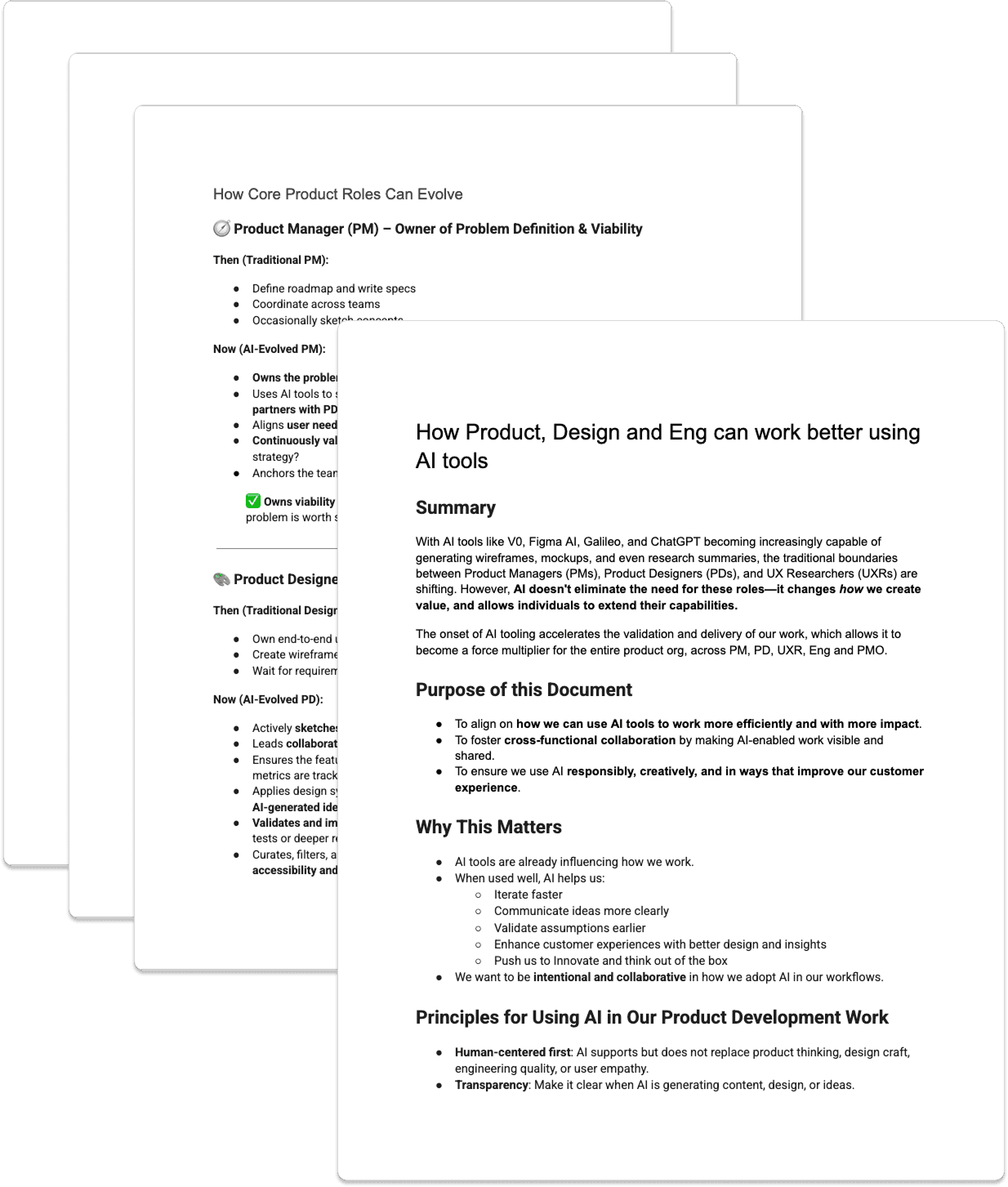
A cross-functional playbook I created to help team navigate conversations around roles and responsibilities.
A cross-functional playbook I created to help team navigate conversations around roles and responsibilities.
outcomes
As AI prototyping tools became more common, they created real anxiety inside the design team—especially as Product Managers began using tools like v0 and Figma Make to express ideas visually.
I helped the team navigate that shift by creating workshops, dialogue, and a practical playbook that reframed AI as a way to expand participation, not diminish design. I helped guide them to take ownership of these tools and celebrated it when they did.
Over time, I saw a healthier dynamic emerge: designers moved from reacting defensively to AI-generated prototypes to actively engaging with them, critiquing them, and helping shape better outcomes. They became more comfortable with AI in their workflows, removing the emotional tension and feeling more empowered.
reflection
This work reinforced for me that AI adoption is fundamentally a people and workflow challenge, not just a tooling one.
When more people can prototype, the answer is not to defend rigid role boundaries, but to clarify the distinct value each function still brings.
Product, Design, and Engineering continue to represent different forms of judgment—business, user, and technical—and that tension still matters.
The opportunity is not to flatten those differences, but to use AI to help everyone work faster and better without lowering the quality bar.
Leading through the AI shift
In 2023, AI tools were rapidly changing how teams could prototype, synthesize research, and generate copy. At BigCommerce, usage was uneven, ad-hoc and curiosity-driven. As PMs began prototyping in v0 and Figma Make, the lines between Product, Design, and Engineering started to blur. Design needed to lead — not react.
created space to explore
I ran a 4-day Product Design Summit to push the team into AI thinking. The goal was to bring forward AI concepts that reduced merchant friction across 4 of our strategic pillars: Storefronts, B2B, International and Product Catalog.
Outputs: 10–20 AI concepts that we used for many projects, including a new headless storefront, a B2B quote generator and the seeds of BigAI Copywriter, a generative AI product the team shipped to merchants in 2024.
I organized the team into 4 groups for in-person work across geos. Each team started with a FigJam board that had prompts to explore AI for their specific strategic focus area based on known user needs - this was in 2023. The tools available to use were very different than today's, but we needed to identify next-gen applications in our products.
Some of the concepts that came out of the spring for an AI powered B2B quote generator. This was added to the product roadmap.
We came up with 10-20 solid ideas with AI capabilities. This concept that my breakout team creted handles product translations at scale. Our BigAI Copywriter, a product description generator which was launched in 2024 came out of these workshops.
USed AI to streamline our workflows
I encouraged the team to use AI in their work - we experimented with using AI generated images from Dall-E, but we learned that it wasn't ready yet - it was bad at displaying the front and back of a person wearing an outfit, for example. However, we were able to use it to generate images for our B2B storefront templates.
After we lost our UX writer, we published the writing guide and created a UX writing bot to ensure the writing guide was accessible to designers and product managers.
Considering copyright issues, we used AI generated images with Adobe Firefly to illustrate a B2B centric storefront template.
To maintain consistency across a multi-disciplinary team, we launched a GPT-powered writing assistant. It automated adherence to our style guide, ensuring the right tone and voice while significantly speeding up the drafting process.
examples: delivery & craft
examples: discovery
I used ChatGPT to map out high level steps of a merchant journey, based on conversations with sales and account managers. These were used in designing 0—>1 product experiences, including onbaording and the redesign of our Catalyst headless storefront experience.
A non-English speaking product designer was able to create her own survey, with a research review first.
We used Claude 3.5 to help brainstorm how to show unlimited inventory in backorders, and it surfaced the infinity symbol idea that we ended up using. It was a simple example of how AI can be genuinely useful in early design exploration, and even help with innovation.
launched ai powered products
In 2024, BigAI Copywriter was a first step to bring AI into our products. This was designed to help merchants with the time-consuming task of writing SEO optimized product descriptions. To launch quickly, we built v1 as a free integration. A Senior Designer on my team designed this.
Merchants liked this functionality, but wanted more improvements, including:
It needed to be backwards compatible with our v2 Catalog API
We needed to be able to store brand attributes for reusability
It needed to be launched in other languages
We gave people flexibility to choose word limit, style, product information, and optimized it for SEO. In hindsight, I would have had fewer controls, a brand guide and a more obvious way to refresh.
We designed a slide out for an AI companion that opened and closed, with the content viewable rather than covering it, and a keystroke control. Although this launched after I left, I helped shape the concept.
evolved a shared practice
Initially, PMs started creating their own prototypes in v0, the designers were confused about their roles. I drafted a cross-functional AI playbook and principles — defining principles, risks, role evolution, and where AI fit in our workflows. I shared it with our CPO and used it to give clarity to teams.
A cross-functional playbook I created to help team navigate conversations around roles and responsibilities.
Principles to anchor experimentation in good judgment — making sure speed never came at the cost of craft, transparency, or user trust.
outcomes
The work helped shift AI from an abstract strategic conversation into something teams could actively prototype, evaluate, and integrate into real product workflows.
Outcomes included:
Launch one of BigCommerce’s first AI-powered merchant tools
Experimentation across Product, Design, and Engineering
AI-assisted workflows for prototyping, UX writing, and synthesis
Designers became more comfortable working with emerging AI tooling
Influenced later launch of AI support companion
reflection
AI changes execution speed faster than product judgment
AI dramatically accelerated prototyping and production workflows, but teams still need strong product thinking, systems design, and user and craft-centered judgment to create coherent experiences.
AI works best when embedded into existing workflows
The most promising concepts were not standalone AI tools, but experiences to support existing friction-laden merchant tasks like onboarding, catalog management, and support.
Design organizations must evolve alongside engineering acceleration
As engineers and PMs adopted AI tooling rapidly, design teams needed new workflows, technical fluency, and experimentation models to stay closely connected to product development.
The role of design becomes more important in AI-native systems
Faster engineering cycles meant design had to show up earlier and with a point of view, shaping trust, orchestration, and human-AI interaction before handoff, not after.
outcomes
The work helped shift AI from an abstract strategic conversation into something teams could actively prototype, evaluate, and integrate into real product workflows.
Outcomes included:
Launch one of BigCommerce’s first AI-powered merchant tools
Experimentation across Product, Design, and Engineering
AI-assisted workflows for prototyping, UX writing, and synthesis
Designers became more comfortable working with emerging AI tooling
Influenced later launch of AI support companion
reflection
AI changes execution speed faster than product judgment
AI dramatically accelerated prototyping and production workflows, but teams still need strong product thinking, systems design, and user and craft-centered judgment to create coherent experiences.
AI works best when embedded into existing workflows
The most promising concepts were not standalone AI tools, but experiences to support existing friction-laden merchant tasks like onboarding, catalog management, and support.
Design organizations must evolve alongside engineering acceleration
As engineers and PMs adopted AI tooling rapidly, design teams needed new workflows, technical fluency, and experimentation models to stay closely connected to product development.
The role of design becomes more important in AI-native systems
Faster engineering cycles meant design had to show up earlier and with a point of view, shaping trust, orchestration, and human-AI interaction before handoff, not after.
AI / Emerging tech
Complex workflows
Org enablement
Global commerce
Creating an AI-ready product design organization
Company
BigCommerce
Role
Director / Senior Director Product Design
Scope
AI-enabled workflows, generative AI authoring, opportunity discovery
Year
2023-25
Helping a global commerce platform explore building AI-native product experiences and modernize internal design workflows during the rise of generative AI.
A FigJam board from a workshop where the team did screen shares of how they were working with AI. The goal of the workshop was to explore how to make our workflows more efficient, maintain quality and determine how we communicate and keep momentum on learning.
A FigJam board from a workshop where the team did screen shares of how they were working with AI. The goal of the workshop was to explore how to make our workflows more efficient, maintain quality and determine how we communicate and keep momentum on learning.
The moment
As generative AI rapidly reshaped software expectations, our organization faced a growing gap between AI excitement and operational readiness. Product teams lacked clear frameworks for how AI should fit into merchant workflows, while designers were navigating uncertainty around how AI would reshape their own practice.
As PMs and engineers began rapidly prototyping with AI tooling, many designers worried design would be left out. I saw the opportunity as one for design to reposition itself as a discipline responsible for shaping clarity, workflows, and trust in AI-native experiences.
my approach
1. Created Space for Exploration
Ran a 4-day Product Design Summit across four strategic pillars, generating 10–20 AI concepts — including a B2B quote generator and the seeds of BigAI Copywriter.
2. Used AI to Improve Discovery and Delivery
Expanded the team's capabilities on both ends — using AI to accelerate synthesis and journey mapping in research, and to maintain craft and consistency in design delivery.
3. launched ai-powered products
Helped bring BigAI Copywriter to market as a free standalone integration, helping merchants generate SEO-optimized product descriptions at scale.
4. evolved a shared practice
Drafted a cross-functional AI playbook covering principles, risks, and role evolution — giving Product, Design, and Engineering shared language and confident footing.
Leading through the AI shift
createD space for exploration
I ran a 4-day Product Design Summit to push the team into AI thinking. The goal was to bring forward AI concepts that reduced merchant friction across 4 of our strategic pillars: Storefronts, B2B, International and Product Catalog.
Outputs: 10–20 AI concepts that we used for many projects, including a new headless storefront, a B2B quote generator and the seeds of BigAI Copywriter, a generative AI product the team shipped to merchants in 2024.
I organized the team into 4 groups for in-person work across geos. Each team started with a FigJam board that had prompts to explore AI for their specific strategic focus area based on known user needs - this was in 2023. The tools available to use were very different than today's, but we needed to identify next-gen applications in our products.
Some of the concepts that came out of the spring for an AI powered B2B quote generator. This was added to the product roadmap.
We came up with 10-15 solid ideas with AI capabilities. This concept that my breakout team created uses AI to handle product translations at scale. Our BigAI Copywriter, a product description generator which was launched in 2024 came out of these workshops.
USed AI to improve discovery and delivery
I strongly encouraged the team to use AI in their work. We realized that it could help the researchers with discovery and the designers with delivery. AI was expanding our abilities in each of these categories.
Ai as an expansion enabler
AI expanded both the speed and breadth of exploration across research, synthesis, prototyping, and delivery workflows.
examples: discovery
I used ChatGPT to map out high level steps of a merchant journey, based on conversations with sales and account managers. These were used in designing 0—>1 product experiences, including onbaording and the redesign of our Catalyst headless storefront experience.
A non-English speaking product designer was able to create her own survey, with a research review first.
A product designer was able to create her own survey, with a research review first.
examples: delivery & craft
AI elevated our ability to craft images in a specific style for templates. We used AI generated product images from Adobe Firefly in an industrial 3D style to illustrate a B2B centric storefront template.
To maintain consistency across a multi-disciplinary team, we launched a GPT-powered writing assistant. It automated adherence to our style guide, ensuring the right tone and voice while significantly speeding up the drafting process.
We used Claude 3.5 to help brainstorm how to show unlimited inventory in backorders, and it surfaced the infinity symbol idea that we ended up using. It was a simple example of how AI can be genuinely useful in early design exploration, and even help with innovation.
launched ai-powered products
Bigai copywriter
In 2024, BigAI Copywriter became our first attempt to bring generative AI directly into the merchant experience. The goal was to reduce the friction of writing SEO-optimized product descriptions for large catalogs.
To move quickly, we launched v1 as a free standalone integration. A Senior Designer on my team led the design work with my guidance around workflow integration, AI interaction patterns, and long-term platform considerations.
The project surfaced deeper product and workflow questions:
Where should AI appear within the authoring flow?
How much merchant control should exist?
How do we preserve trust in generated outputs?
Should AI interactions be inline or separated?
How should prompts and brand context shape output quality?
To launch quickly, BigAI copywriter was launched as an app that was accessible from product descriptions.
Building it as an app exposed platform challenges including compatibility with our Catalog v2 APIs, reusable brand context, multilingual support, tighter integration into existing workflows
One of the learnings was that AI works best when embedded directly into existing workflows rather than treated as a separate tool. While the standalone integration helped us validate demand quickly, it also introduced friction by separating generation from the natural catalog-authoring experience.
AI support experience
I helped push forward the idea of an embedded AI companion designed to guide merchants and developers through complex workflows like store setup and integrations. While the solution launched after I left BigCommerce, it grew out of earlier onboarding and support explorations my team had been driving.
The goal was to surface contextual guidance directly within the workflow, reducing the need for users to search across large amounts of documentation.
AI companion: We designed a slide out for an AI companion that opened and closed, with the content viewable rather than covering it, and a keystroke control. Although this launched after I left, I helped shape the concept.
evolved a shared practice
When PMs started creating their own prototypes in v0, the designers became confused about their roles. With the help of the team, I drafted a cross-functional AI playbook and defined principles, risks, role evolution, and where AI fit in our workflows. I shared it with our CPO and used it to give clarity to teams.
Principles to anchor experimentation in good judgment — making sure speed never came at the cost of craft, transparency, or user trust.
A cross-functional playbook I created to help team navigate conversations around roles and responsibilities.
A cross-functional playbook I created to help team navigate conversations around roles and responsibilities.
outcomes
As AI prototyping tools became more common, they created real anxiety inside the design team—especially as Product Managers began using tools like v0 and Figma Make to express ideas visually.
I helped the team navigate that shift by creating workshops, dialogue, and a practical playbook that reframed AI as a way to expand participation, not diminish design. I helped guide them to take ownership of these tools and celebrated it when they did.
Over time, I saw a healthier dynamic emerge: designers moved from reacting defensively to AI-generated prototypes to actively engaging with them, critiquing them, and helping shape better outcomes. They became more comfortable with AI in their workflows, removing the emotional tension and feeling more empowered.
reflection
This work reinforced for me that AI adoption is fundamentally a people and workflow challenge, not just a tooling one.
When more people can prototype, the answer is not to defend rigid role boundaries, but to clarify the distinct value each function still brings.
Product, Design, and Engineering continue to represent different forms of judgment—business, user, and technical—and that tension still matters.
The opportunity is not to flatten those differences, but to use AI to help everyone work faster and better without lowering the quality bar.
Leading through the AI shift
In 2023, AI tools were rapidly changing how teams could prototype, synthesize research, and generate copy. At BigCommerce, usage was uneven, ad-hoc and curiosity-driven. As PMs began prototyping in v0 and Figma Make, the lines between Product, Design, and Engineering started to blur. Design needed to lead — not react.
created space to explore
I ran a 4-day Product Design Summit to push the team into AI thinking. The goal was to bring forward AI concepts that reduced merchant friction across 4 of our strategic pillars: Storefronts, B2B, International and Product Catalog.
Outputs: 10–20 AI concepts that we used for many projects, including a new headless storefront, a B2B quote generator and the seeds of BigAI Copywriter, a generative AI product the team shipped to merchants in 2024.
I organized the team into 4 groups for in-person work across geos. Each team started with a FigJam board that had prompts to explore AI for their specific strategic focus area based on known user needs - this was in 2023. The tools available to use were very different than today's, but we needed to identify next-gen applications in our products.
Some of the concepts that came out of the spring for an AI powered B2B quote generator. This was added to the product roadmap.
We came up with 10-20 solid ideas with AI capabilities. This concept that my breakout team creted handles product translations at scale. Our BigAI Copywriter, a product description generator which was launched in 2024 came out of these workshops.
USed AI to streamline our workflows
I encouraged the team to use AI in their work - we experimented with using AI generated images from Dall-E, but we learned that it wasn't ready yet - it was bad at displaying the front and back of a person wearing an outfit, for example. However, we were able to use it to generate images for our B2B storefront templates.
After we lost our UX writer, we published the writing guide and created a UX writing bot to ensure the writing guide was accessible to designers and product managers.
Considering copyright issues, we used AI generated images with Adobe Firefly to illustrate a B2B centric storefront template.
To maintain consistency across a multi-disciplinary team, we launched a GPT-powered writing assistant. It automated adherence to our style guide, ensuring the right tone and voice while significantly speeding up the drafting process.
examples: delivery & craft
examples: discovery
I used ChatGPT to map out high level steps of a merchant journey, based on conversations with sales and account managers. These were used in designing 0—>1 product experiences, including onbaording and the redesign of our Catalyst headless storefront experience.
A non-English speaking product designer was able to create her own survey, with a research review first.
We used Claude 3.5 to help brainstorm how to show unlimited inventory in backorders, and it surfaced the infinity symbol idea that we ended up using. It was a simple example of how AI can be genuinely useful in early design exploration, and even help with innovation.
launched ai powered products
In 2024, BigAI Copywriter was a first step to bring AI into our products. This was designed to help merchants with the time-consuming task of writing SEO optimized product descriptions. To launch quickly, we built v1 as a free integration. A Senior Designer on my team designed this.
Merchants liked this functionality, but wanted more improvements, including:
It needed to be backwards compatible with our v2 Catalog API
We needed to be able to store brand attributes for reusability
It needed to be launched in other languages
We gave people flexibility to choose word limit, style, product information, and optimized it for SEO. In hindsight, I would have had fewer controls, a brand guide and a more obvious way to refresh.
We designed a slide out for an AI companion that opened and closed, with the content viewable rather than covering it, and a keystroke control. Although this launched after I left, I helped shape the concept.
evolved a shared practice
Initially, PMs started creating their own prototypes in v0, the designers were confused about their roles. I drafted a cross-functional AI playbook and principles — defining principles, risks, role evolution, and where AI fit in our workflows. I shared it with our CPO and used it to give clarity to teams.
A cross-functional playbook I created to help team navigate conversations around roles and responsibilities.
Principles to anchor experimentation in good judgment — making sure speed never came at the cost of craft, transparency, or user trust.
outcomes
The work helped shift AI from an abstract strategic conversation into something teams could actively prototype, evaluate, and integrate into real product workflows.
Outcomes included:
Launch one of BigCommerce’s first AI-powered merchant tools
Experimentation across Product, Design, and Engineering
AI-assisted workflows for prototyping, UX writing, and synthesis
Designers became more comfortable working with emerging AI tooling
Influenced later launch of AI support companion
reflection
AI changes execution speed faster than product judgment
AI dramatically accelerated prototyping and production workflows, but teams still need strong product thinking, systems design, and user and craft-centered judgment to create coherent experiences.
AI works best when embedded into existing workflows
The most promising concepts were not standalone AI tools, but experiences to support existing friction-laden merchant tasks like onboarding, catalog management, and support.
Design organizations must evolve alongside engineering acceleration
As engineers and PMs adopted AI tooling rapidly, design teams needed new workflows, technical fluency, and experimentation models to stay closely connected to product development.
The role of design becomes more important in AI-native systems
Faster engineering cycles meant design had to show up earlier and with a point of view, shaping trust, orchestration, and human-AI interaction before handoff, not after.
outcomes
The work helped shift AI from an abstract strategic conversation into something teams could actively prototype, evaluate, and integrate into real product workflows.
Outcomes included:
Launch one of BigCommerce’s first AI-powered merchant tools
Experimentation across Product, Design, and Engineering
AI-assisted workflows for prototyping, UX writing, and synthesis
Designers became more comfortable working with emerging AI tooling
Influenced later launch of AI support companion
reflection
AI changes execution speed faster than product judgment
AI dramatically accelerated prototyping and production workflows, but teams still need strong product thinking, systems design, and user and craft-centered judgment to create coherent experiences.
AI works best when embedded into existing workflows
The most promising concepts were not standalone AI tools, but experiences to support existing friction-laden merchant tasks like onboarding, catalog management, and support.
Design organizations must evolve alongside engineering acceleration
As engineers and PMs adopted AI tooling rapidly, design teams needed new workflows, technical fluency, and experimentation models to stay closely connected to product development.
The role of design becomes more important in AI-native systems
Faster engineering cycles meant design had to show up earlier and with a point of view, shaping trust, orchestration, and human-AI interaction before handoff, not after.
AI / Emerging tech
Complex workflows
Org enablement
Global commerce
Creating an AI-ready product design organization
Company
BigCommerce
Role
Director / Senior Director Product Design
Scope
AI-enabled workflows, generative AI authoring, opportunity discovery
Year
2023-25
Helping a global commerce platform explore building AI-native product experiences and modernize internal design workflows during the rise of generative AI.
A FigJam board from a workshop where the team did screen shares of how they were working with AI. The goal of the workshop was to explore how to make our workflows more efficient, maintain quality and determine how we communicate and keep momentum on learning.
A FigJam board from a workshop where the team did screen shares of how they were working with AI. The goal of the workshop was to explore how to make our workflows more efficient, maintain quality and determine how we communicate and keep momentum on learning.
The moment
As generative AI rapidly reshaped software expectations, our organization faced a growing gap between AI excitement and operational readiness. Product teams lacked clear frameworks for how AI should fit into merchant workflows, while designers were navigating uncertainty around how AI would reshape their own practice.
As PMs and engineers began rapidly prototyping with AI tooling, many designers worried design would be left out. I saw the opportunity as one for design to reposition itself as a discipline responsible for shaping clarity, workflows, and trust in AI-native experiences.
my approach
1. Created Space for Exploration
Ran a 4-day Product Design Summit across four strategic pillars, generating 10–20 AI concepts — including a B2B quote generator and the seeds of BigAI Copywriter.
2. Used AI to Improve Discovery and Delivery
Expanded the team's capabilities on both ends — using AI to accelerate synthesis and journey mapping in research, and to maintain craft and consistency in design delivery.
3. launched ai-powered products
Helped bring BigAI Copywriter to market as a free standalone integration, helping merchants generate SEO-optimized product descriptions at scale.
4. evolved a shared practice
Drafted a cross-functional AI playbook covering principles, risks, and role evolution — giving Product, Design, and Engineering shared language and confident footing.
Leading through the AI shift
createD space for exploration
I ran a 4-day Product Design Summit to push the team into AI thinking. The goal was to bring forward AI concepts that reduced merchant friction across 4 of our strategic pillars: Storefronts, B2B, International and Product Catalog.
Outputs: 10–20 AI concepts that we used for many projects, including a new headless storefront, a B2B quote generator and the seeds of BigAI Copywriter, a generative AI product the team shipped to merchants in 2024.
I organized the team into 4 groups for in-person work across geos. Each team started with a FigJam board that had prompts to explore AI for their specific strategic focus area based on known user needs - this was in 2023. The tools available to use were very different than today's, but we needed to identify next-gen applications in our products.
Some of the concepts that came out of the spring for an AI powered B2B quote generator. This was added to the product roadmap.
We came up with 10-15 solid ideas with AI capabilities. This concept that my breakout team created uses AI to handle product translations at scale. Our BigAI Copywriter, a product description generator which was launched in 2024 came out of these workshops.
USed AI to improve discovery and delivery
I strongly encouraged the team to use AI in their work. We realized that it could help the researchers with discovery and the designers with delivery. AI was expanding our abilities in each of these categories.
Ai as an expansion enabler
AI expanded both the speed and breadth of exploration across research, synthesis, prototyping, and delivery workflows.
examples: discovery
I used ChatGPT to map out high level steps of a merchant journey, based on conversations with sales and account managers. These were used in designing 0—>1 product experiences, including onbaording and the redesign of our Catalyst headless storefront experience.
A non-English speaking product designer was able to create her own survey, with a research review first.
A product designer was able to create her own survey, with a research review first.
examples: delivery & craft
AI elevated our ability to craft images in a specific style for templates. We used AI generated product images from Adobe Firefly in an industrial 3D style to illustrate a B2B centric storefront template.
To maintain consistency across a multi-disciplinary team, we launched a GPT-powered writing assistant. It automated adherence to our style guide, ensuring the right tone and voice while significantly speeding up the drafting process.
We used Claude 3.5 to help brainstorm how to show unlimited inventory in backorders, and it surfaced the infinity symbol idea that we ended up using. It was a simple example of how AI can be genuinely useful in early design exploration, and even help with innovation.
launched ai-powered products
Bigai copywriter
In 2024, BigAI Copywriter became our first attempt to bring generative AI directly into the merchant experience. The goal was to reduce the friction of writing SEO-optimized product descriptions for large catalogs.
To move quickly, we launched v1 as a free standalone integration. A Senior Designer on my team led the design work with my guidance around workflow integration, AI interaction patterns, and long-term platform considerations.
The project surfaced deeper product and workflow questions:
Where should AI appear within the authoring flow?
How much merchant control should exist?
How do we preserve trust in generated outputs?
Should AI interactions be inline or separated?
How should prompts and brand context shape output quality?
To launch quickly, BigAI copywriter was launched as an app that was accessible from product descriptions.
Building it as an app exposed platform challenges including compatibility with our Catalog v2 APIs, reusable brand context, multilingual support, tighter integration into existing workflows
One of the learnings was that AI works best when embedded directly into existing workflows rather than treated as a separate tool. While the standalone integration helped us validate demand quickly, it also introduced friction by separating generation from the natural catalog-authoring experience.
AI support experience
I helped push forward the idea of an embedded AI companion designed to guide merchants and developers through complex workflows like store setup and integrations. While the solution launched after I left BigCommerce, it grew out of earlier onboarding and support explorations my team had been driving.
The goal was to surface contextual guidance directly within the workflow, reducing the need for users to search across large amounts of documentation.
AI companion: We designed a slide out for an AI companion that opened and closed, with the content viewable rather than covering it, and a keystroke control. Although this launched after I left, I helped shape the concept.
evolved a shared practice
When PMs started creating their own prototypes in v0, the designers became confused about their roles. With the help of the team, I drafted a cross-functional AI playbook and defined principles, risks, role evolution, and where AI fit in our workflows. I shared it with our CPO and used it to give clarity to teams.
Principles to anchor experimentation in good judgment — making sure speed never came at the cost of craft, transparency, or user trust.
A cross-functional playbook I created to help team navigate conversations around roles and responsibilities.
A cross-functional playbook I created to help team navigate conversations around roles and responsibilities.
outcomes
As AI prototyping tools became more common, they created real anxiety inside the design team—especially as Product Managers began using tools like v0 and Figma Make to express ideas visually.
I helped the team navigate that shift by creating workshops, dialogue, and a practical playbook that reframed AI as a way to expand participation, not diminish design. I helped guide them to take ownership of these tools and celebrated it when they did.
Over time, I saw a healthier dynamic emerge: designers moved from reacting defensively to AI-generated prototypes to actively engaging with them, critiquing them, and helping shape better outcomes. They became more comfortable with AI in their workflows, removing the emotional tension and feeling more empowered.
reflection
This work reinforced for me that AI adoption is fundamentally a people and workflow challenge, not just a tooling one.
When more people can prototype, the answer is not to defend rigid role boundaries, but to clarify the distinct value each function still brings.
Product, Design, and Engineering continue to represent different forms of judgment—business, user, and technical—and that tension still matters.
The opportunity is not to flatten those differences, but to use AI to help everyone work faster and better without lowering the quality bar.
Leading through the AI shift
In 2023, AI tools were rapidly changing how teams could prototype, synthesize research, and generate copy. At BigCommerce, usage was uneven, ad-hoc and curiosity-driven. As PMs began prototyping in v0 and Figma Make, the lines between Product, Design, and Engineering started to blur. Design needed to lead — not react.
created space to explore
I ran a 4-day Product Design Summit to push the team into AI thinking. The goal was to bring forward AI concepts that reduced merchant friction across 4 of our strategic pillars: Storefronts, B2B, International and Product Catalog.
Outputs: 10–20 AI concepts that we used for many projects, including a new headless storefront, a B2B quote generator and the seeds of BigAI Copywriter, a generative AI product the team shipped to merchants in 2024.
I organized the team into 4 groups for in-person work across geos. Each team started with a FigJam board that had prompts to explore AI for their specific strategic focus area based on known user needs - this was in 2023. The tools available to use were very different than today's, but we needed to identify next-gen applications in our products.
Some of the concepts that came out of the spring for an AI powered B2B quote generator. This was added to the product roadmap.
We came up with 10-20 solid ideas with AI capabilities. This concept that my breakout team creted handles product translations at scale. Our BigAI Copywriter, a product description generator which was launched in 2024 came out of these workshops.
USed AI to streamline our workflows
I encouraged the team to use AI in their work - we experimented with using AI generated images from Dall-E, but we learned that it wasn't ready yet - it was bad at displaying the front and back of a person wearing an outfit, for example. However, we were able to use it to generate images for our B2B storefront templates.
After we lost our UX writer, we published the writing guide and created a UX writing bot to ensure the writing guide was accessible to designers and product managers.
Considering copyright issues, we used AI generated images with Adobe Firefly to illustrate a B2B centric storefront template.
To maintain consistency across a multi-disciplinary team, we launched a GPT-powered writing assistant. It automated adherence to our style guide, ensuring the right tone and voice while significantly speeding up the drafting process.
examples: delivery & craft
examples: discovery
I used ChatGPT to map out high level steps of a merchant journey, based on conversations with sales and account managers. These were used in designing 0—>1 product experiences, including onbaording and the redesign of our Catalyst headless storefront experience.
A non-English speaking product designer was able to create her own survey, with a research review first.
We used Claude 3.5 to help brainstorm how to show unlimited inventory in backorders, and it surfaced the infinity symbol idea that we ended up using. It was a simple example of how AI can be genuinely useful in early design exploration, and even help with innovation.
launched ai powered products
In 2024, BigAI Copywriter was a first step to bring AI into our products. This was designed to help merchants with the time-consuming task of writing SEO optimized product descriptions. To launch quickly, we built v1 as a free integration. A Senior Designer on my team designed this.
Merchants liked this functionality, but wanted more improvements, including:
It needed to be backwards compatible with our v2 Catalog API
We needed to be able to store brand attributes for reusability
It needed to be launched in other languages
We gave people flexibility to choose word limit, style, product information, and optimized it for SEO. In hindsight, I would have had fewer controls, a brand guide and a more obvious way to refresh.
We designed a slide out for an AI companion that opened and closed, with the content viewable rather than covering it, and a keystroke control. Although this launched after I left, I helped shape the concept.
evolved a shared practice
Initially, PMs started creating their own prototypes in v0, the designers were confused about their roles. I drafted a cross-functional AI playbook and principles — defining principles, risks, role evolution, and where AI fit in our workflows. I shared it with our CPO and used it to give clarity to teams.
A cross-functional playbook I created to help team navigate conversations around roles and responsibilities.
Principles to anchor experimentation in good judgment — making sure speed never came at the cost of craft, transparency, or user trust.
outcomes
The work helped shift AI from an abstract strategic conversation into something teams could actively prototype, evaluate, and integrate into real product workflows.
Outcomes included:
Launch one of BigCommerce’s first AI-powered merchant tools
Experimentation across Product, Design, and Engineering
AI-assisted workflows for prototyping, UX writing, and synthesis
Designers became more comfortable working with emerging AI tooling
Influenced later launch of AI support companion
reflection
AI changes execution speed faster than product judgment
AI dramatically accelerated prototyping and production workflows, but teams still need strong product thinking, systems design, and user and craft-centered judgment to create coherent experiences.
AI works best when embedded into existing workflows
The most promising concepts were not standalone AI tools, but experiences to support existing friction-laden merchant tasks like onboarding, catalog management, and support.
Design organizations must evolve alongside engineering acceleration
As engineers and PMs adopted AI tooling rapidly, design teams needed new workflows, technical fluency, and experimentation models to stay closely connected to product development.
The role of design becomes more important in AI-native systems
Faster engineering cycles meant design had to show up earlier and with a point of view, shaping trust, orchestration, and human-AI interaction before handoff, not after.
outcomes
The work helped shift AI from an abstract strategic conversation into something teams could actively prototype, evaluate, and integrate into real product workflows.
Outcomes included:
Launch one of BigCommerce’s first AI-powered merchant tools
Experimentation across Product, Design, and Engineering
AI-assisted workflows for prototyping, UX writing, and synthesis
Designers became more comfortable working with emerging AI tooling
Influenced later launch of AI support companion
reflection
AI changes execution speed faster than product judgment
AI dramatically accelerated prototyping and production workflows, but teams still need strong product thinking, systems design, and user and craft-centered judgment to create coherent experiences.
AI works best when embedded into existing workflows
The most promising concepts were not standalone AI tools, but experiences to support existing friction-laden merchant tasks like onboarding, catalog management, and support.
Design organizations must evolve alongside engineering acceleration
As engineers and PMs adopted AI tooling rapidly, design teams needed new workflows, technical fluency, and experimentation models to stay closely connected to product development.
The role of design becomes more important in AI-native systems
Faster engineering cycles meant design had to show up earlier and with a point of view, shaping trust, orchestration, and human-AI interaction before handoff, not after.